Launching today

Clinical Trial Radar
Find Clinical Trials with AI
2 followers
Find Clinical Trials with AI
2 followers
Find and understand clinical trials with AI, free and with no signup. Ask in plain words or filter 525K+ studies by condition, phase and distance. Every answer cites its sources: the ClinicalTrials.gov record, PubMed and FDA data. Get eligibility criteria in plain language, prepare questions for the study team, compare up to five studies and see sites on a map. Save, share or print what you find, and get alerts when a study changes. In 13 languages, on the web, iOS and Android.


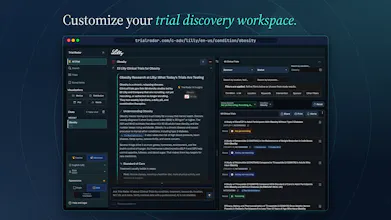


🧬 Breakthroughs in drug discovery with AI? That means more clinical trials are coming, so let's solve trial discovery too! Trial Radar helps people find, understand, and access emerging treatments through clinical trials, in 13 languages, free and for everyone. It's live at trialradar.com and now on the App Store and Google Play.
Why we built it. ClinicalTrials.gov lists more than 525,000 studies. It's the authoritative source, but it's written for researchers and regulators: eligibility criteria run for pages, statuses change without notice, and searching works best in English. AI chatbots are easier to talk to, but they can't tell you whether a study is still recruiting near you, and they rarely show where an answer came from. Meanwhile, the people looking are often doing it late at night after a hard diagnosis, on a phone, and sometimes in their second language. (We also keep a free directory of trial registries and search tools worldwide, because no single site covers everything.)
What you can do with Trial Radar
🔎 Find studies. Search clinical trials by asking in plain words, like "recruiting phase 3 lung cancer trials near Boston", or filter by condition, treatment, sponsor, phase, status, age, and distance. Searches run against the live registry, which we refresh daily, covering 220+ countries and all 50 U.S. states.
📖 Understand them. Get any study, medical term, or eligibility criterion explained in plain language. Answers cite the study record, PubMed articles, and FDA drug information, so you can check them yourself.
🩺 Prepare for the conversation. The Participation Assistant walks you through a study's criteria and helps you write down questions for the study team. Clinicians can generate a checklist instead. It explains the criteria; only the study team decides who qualifies.
⚖️ Keep track. Compare up to five saved studies side by side, print a clean summary for your next appointment, share a conversation with family or your doctor, and get alerts when a study you follow changes.
Private by design. There's no account to create. Your saved studies and conversations stay on your device. The Participation Assistant only processes health information after you explicitly agree, and ending the conversation asks the AI provider to delete it. Shared links expire after 30 days unless you renew them, and you can delete them anytime. The details are in our privacy policy.
Built for every language we support. Trial Radar works in 13 languages, including Arabic and Hebrew with full right-to-left layouts. Medical conditions and treatments are translated with care rather than run through machine translation on the fly, so a family in São Paulo, Seoul, or Tel Aviv can read the same study as one in Boston.
For sponsors and organizations. More than 1,000 sponsor and organization pages bring together each portfolio's studies, a cited AI overview, and charts for phase, enrollment, geography, and timelines. They update from the registry automatically, so they never go stale. Interested in working with us? See our partner page.
For the builders 👋 Before any tool runs, a planner decides how to research the question: registry only, literature first, FDA data, or the registry plus the web. Citations work the same way whether you're watching an answer stream, reopening a saved chat, viewing a shared link, or printing. Several AI providers sit behind one interface with automatic fallback, and search-engine crawlers get cached answers, which helps keep the whole thing free. The frontend is plain Web Components with no framework. We're grateful to the public registries and open-source projects that make all of this possible.
Is it really free? Yes. A daily limit on AI requests is how we keep it that way. More answers are in our FAQ.
How you can help: try a real question about your own condition, a family member's, or a drug you've been reading about. Then tell us where an answer was unclear, a source was missing, or the translation could be better. If you run a patient community or advocacy group, we'd love to hear from you.
Trial Radar is an information tool, not medical advice. It doesn't determine eligibility or enroll anyone in a study, so always check with the study team and your doctor. It isn't affiliated with ClinicalTrials.gov, NLM, NIH, or the FDA.