
CipherWrite
Write what you can't share anywhere else
4 followers
Write what you can't share anywhere else
4 followers
Built this after realising writers weren't just failing to finish — they were
writing softer versions of the true thing, because the draft sat readable on
someone's server. Chapters encrypt in your browser with a key I never receive.
The trade-off is real: lose your passphrase and I can't recover your book, and
Scrivener still beats us on compiling. Free tier is a genuine one.
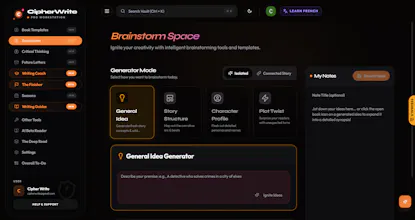

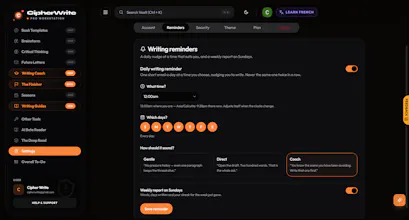
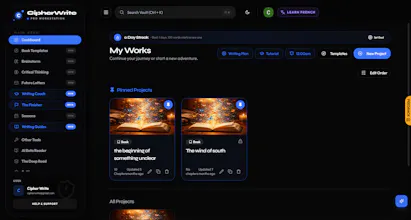
Over the last few months, my head was full. Ideas, overthinking, small wins, mistakes—but there wasn't a safe place to put any of it.
Most writing tools feel social, track everything, or quietly read your data. That's great for "content", but not for the thoughts you can't share anywhere else.
Cipherwrite is my attempt to fix that: a private, encrypted space for journaling and book-writing, where everything is locked before it ever leaves your device. No tracking, no one training models on your words, just you and what you write.
It's meant for people who:
- Journal about mental health, stress, or overthinking
- Draft books, memoirs, or personal essays
- Want a place to brain-dump honestly without worrying who might read it later
I'd really love feedback from this community:
- Does the core idea (privacy-first writing) resonate with you?
- What would you need to see to trust a tool with your deepest thoughts?
- Are there any small details missing that would make you actually write every day?
Thanks for taking the time to check it out and share your thoughts—it means a lot, especially as a solo founder launching here for the first time. 🙏
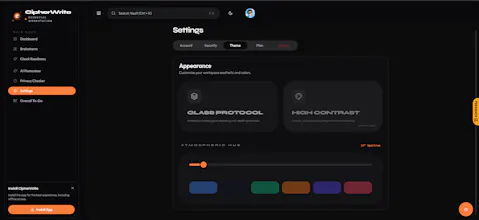
Adjust Page Brightness - Smart Control
i think i should this instead of google notes haha
@kshitij_mishra4 You definitely should
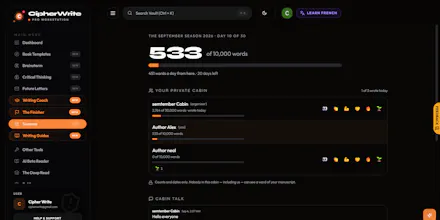
Seasons: a calendar month, a target you pick yourself, and a cabin of six who
can see whether you showed up. They see counts and dates — never a word of your
manuscript, because it's counted in your browser and sent as integers. No post
box in matched cabins, just preset reactions, so nobody has to moderate a room
strangers land in. October opens now, free to join.
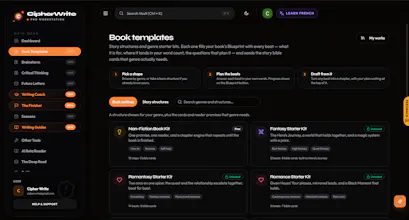
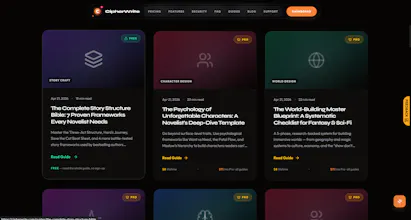
18 craft guides, and they're the reference layer rather than a course. Story
structure, subtext, point of view, the second-act survival guide, the romance
and romantasy beat sheet, the memoir craft handbook, the first chapter
blueprint. Long and specific, written to be returned to at the moment you hit
the problem not read once and felt guilty about.
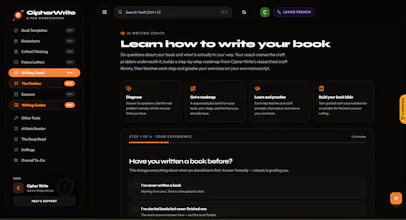
Most writing courses hand you module one and assume everyone is stuck in the
same place. This does the opposite: it works out the mechanical reason you're
stuck first, then builds a roadmap against that diagnosis from a curriculum of
30+ craft modules. Diagnosis before prescription. If your problem is that scenes
have no turn, you don't need a lesson on comps.
The one I'd defend hardest, because knowing what to fix has never been the
reason drafts die — week four is. The Finisher notices when you stall, names
why, and hands you the next scene. It remembers you, not your book: how you
work, when you quit, what got you moving last time. Your chapters stay
encrypted with a key I don't have, so it can't read a word of the manuscript
it's helping you finish. It's in beta and I'd rather hear where it's wrong.