
Bruin
The AI data agent that collaborates with your team
72 followers
The AI data agent that collaborates with your team
72 followers
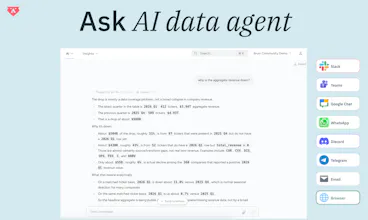
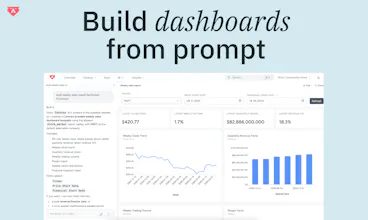
The AI Data Agent that lives, breathes, and collaborates with your team. A data analyst agent that integrates into your Slack, Teams, etc. and built on top a strong context & semantic layer using Bruin's very own open-source tools or from your existing dbt, LookML, etc. Make your agent live inside every conversation, collaborate across teams, deep dive into the data, find insights, and turn them into actionable tasks.



"Collaborates with your team" is the part most data agents undersell. Curious whether your collab surface is synchronous (live chat in-context) or async (PR-style review). Different products entirely.
@pengspirit666 Both actually. The chat interface (web, slack, teams, etc.) is the primary way for collaborating with the agent but if the agent is given access to your repo, it can go ahead and create a PR. This can be updating the metadata, context, and semantics layer or fixing data issues (e.g. fix the join in a SQL asset).
Also worth mentioning that the agent can also take actions as well - for example, it can rerun a pipeline to backfill missing data, or trigger a reverse-ETL asset for a specific client ID to update their CRM profile.
@arsalan_bruin The PR-creation surface is the part I keep coming back to as a
contract-design problem. If the agent can fix a SQL join via PR, the
review surface is doing two jobs at once: catching the agent's bad PR,
and catching scope drift the reviewer would not have noticed without
automation in the loop.
Curious whether you saw reviewer decision-time go up or down once agents
started producing PRs. My intuition is that good PRs from a competent
agent compress review time, but borderline PRs eat more reviewer
attention than equivalent human PRs because the failure mode is
unfamiliar.
The reverse-ETL trigger by client ID is a clean primitive — small enough
scope that an audit-log entry plus a notification covers the read-back
loop. The harder version is the multi-asset cascade where reverse-ETL
into the CRM kicks off a downstream segment recompute. Where do you
draw the line on what the agent can chain without confirmation?
Can Bruin ask follow up questions when a request is not clear?
@karimbenkeroum yep. it allows you to explain the business context and then attributes data to the business context. then if something is vague / irrelevant it asks you back instead of making up numbers/concepts or assuming.
What I found interesting here was the idea of analytics becoming part of the team’s day-to-day conversations instead of something people only check separately through dashboards and reports. It makes the workflow feel much more interactive and accessible for non-technical teams as well.
I did wonder about one thing though — in larger organizations, different teams often interpret or calculate KPIs slightly differently depending on their workflows. How does Bruin handle those differences while still keeping the AI’s analysis and recommendations contextually accurate?
What got me was the lineage screen , seeing how all the data flows from raw to reports visually, and then having an agent sitting on top of that. Most of my experience with data tools is that by the time an insight reaches a business team, nobody remembers where it came from. My question is simpler though , if two different teams ask Bruin the same question but their data is set up slightly differently, does it give them different answers? And if yes, does anyone get notified, or does the inconsistency just quietly exist?
@burakkarakan What I like here is that the agent lives inside Slack where decisions actually happen, instead of being a separate dashboard nobody opens. Curious whether Bruin can ask clarifying questions back when a request is ambiguous — that's usually where data agents hallucinate instead of admitting uncertainty.
Embedding a data agent directly into team conversations is interesting. how are you handling query validation and permission boundaries across shared data environments?