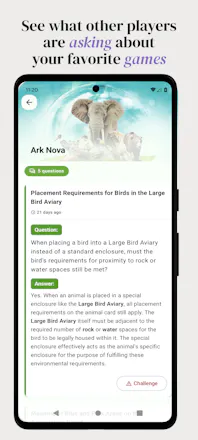
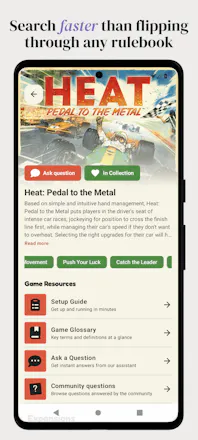
Instead of chatting with a PDF, Board Law pulls relevant information from official rulebooks, FAQs, and errata, then uses AI to write a clear, sourced answer. This dramatically reduces the hallucination problem that plagues general models on long documents. Fine-tuned models deliver fast, consistent answers across thousands of games. Beyond Q&A, it includes setup guides, glossaries, collection management, and community-verified answers - with automatic notifications if a ruling is updated
No reviews yetBe the first to leave a review for Board Law
Maker
📌
Hey everyone! I'm Abraham, the solo developer behind Board Law.
I'm a board gamer. I've been that person at the table pausing the game to dig through a 40-page rulebook to settle a dispute, or making everyone wait while I try to find an answer that's important for my strategy. I built the thing I wanted to exist. A few years ago I left my role as an engineer at Google, where I worked on Google Search for Android. One of the reasons was to build and ship something of my own. Board Law is the result.
The problem - When a rules question comes up mid-game, your options are: flip through the rulebook, Google it and hope someone on BGG asked the same question, or upload the PDF to ChatGPT and hope it doesn't hallucinate. None of these are fast, reliable, or convenient.
The approach - Board Law runs on a fine-tuned model I've built a full infrastructure layer around. The model is specifically trained for rules answers - concise, structured, grounded. The backend retrieves only relevant (pre-processed) passages from official sources and a set of guardrails prevents the model from straying beyond them. None of this worked well out of the box. Early versions were too slow, too verbose, or just wrong. It took constant iteration across the model, the retrieval pipeline, and the guardrails together to get it where it is now: fast, accurate, and consistent across thousands of games.
What changed along the way - Early on, Board Law was just Q&A with a chat interface. But I quickly realised that wasn't enough to make it a true companion app - and that yet another chat UI wasn't going to differentiate it either. I moved away from chat entirely to more limited Q&A and added setup guides, glossaries, expansion support, and collection management. The community layer came later. I initially deprioritised letting players review and correct answers, but now I consider it essential and will be developed further in the future. No system is perfect, and having the community help keep things accurate makes Board Law better for everyone.
Building this solo has meant wearing every hat - engineering, design, marketing, DevOps, support - and honestly, it's been some of the most rewarding work of my career.
Board Law is live on Android and iOS, with a web version coming later this year. I'd love to hear your feedback. If you've got a favourite game with notoriously confusing rules, throw it at Board Law and let me know how it does!