Bloom

Bloom

Decentralized credit scoring powered by Ethereum and IPFS

5.0
1 review

11 followers

Bloom is the future of credit. Bloom does not provide loans. Bloom is a platform to migrate all lenders to the Blockchain. From mortgage providers to local credit unions, lenders across the globe will be able to tap into a far more comprehensive credit database with improved global scoring.
Bloom gallery image
Bloom gallery image
Bloom gallery image
Launch tags:TechWeb3
Launch Team
AppSignal
AppSignal
Built for dev teams, not Fortune 500s.
Promoted

What do you think? …

Rory O'Reilly
This is something I personally need - is the Bloom Slack channel open for outside community involvement? I think the PHers will want to get involved :)
Jesse Leimgruber
@rorybro Yes, we actually just launched it yesterday! Here is the link https://join.slack.com/t/hellobl...
P.J. Leimgruber

Typically, trust and anonymity are at odds. By being on the blockchain, Bloom enables people to trust properties about one another without any centralized authority. The explicit goal is to help lenders pull up people who are good credit risks who the current system deems to be bad credit risks. This allows people who need credit to receive it and for lenders to potentially increase their target markets.

Pros:

Bloom is created a open, and decentralized protocol for lending. IF this works - it will change credit globally.

Cons:

There is a HUGE barrier to mass adoption.

Jesse Leimgruber
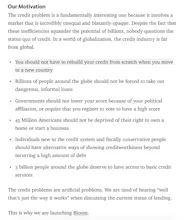
Thanks for the hunt Ben :) We weren't expecting to see Bloom on PH this morning, but definitely very excited to share this with ProductHunt! It's no secret that credit scoring has problems. But in a world of globalization, the credit industry is far from global and nobody seems to question the status quo. - In China, your credit score is affected by your political opinions. - In the United States, 90% of top lenders use FICO (The government frequently cites this as a monopoly.) - 45 million Americans do not have a credit score. Often times because they are fiscally conservative and choose not to take on debt. Yet, this means they are unable to obtain a mortgage to buy a home. - Globally, 3 billion people cannot access credit. This means billions of people around the globe are often forced to take out dangerous, informal loans. These issues are solvable. Many credit bureaus rely on data from the 1970's, failing to take advantage of the wealth of information now available. Bloom is not a provider of loans. Bloom is a platform to migrate all lenders to the Blockchain. From mortgage providers to local credit unions, lenders across the globe will be able to tap into a far more comprehensive credit database and expand their market to three billion new borrowers.
Nick Neuman
@jesserank congrats on the launch! This sounds like it could be really interesting, and I'm excited to see where you guys take it. I think you're spot on with the issues of credit scoring today. However, it would be great to hear more about how you're going to actually use the blockchain to solve those issues. For example: - How do you reconcile cross border differences in credit scoring? China isn't going to suddenly not score based on political opinions just b/c of blockchain, right? - How will this help people without a credit score get better access to credit? Won't banks still want to see a history of on time payments? So a person who has never taken out a loan will still have trouble getting a mortgage? It seems like while the blockchain may help with actual record-keeping, you will still have to convince debt-providers to consider other fundamental information than they currently do when deciding to give someone a loan. This seems like a big challenge, and I'd love to hear your thoughts on how you'll tackle it. Thanks!
Alain Meier
@jesserank @nneuman Hi Nick! These are really good questions. > - How do you reconcile cross border differences in credit scoring? China isn't going to suddenly not score based on political opinions just b/c of blockchain, right? We're going to start with communities within the US who are underrepresented in the credit system to hone the initial score. Internationally we are looking at inferring different lending properties for a given person by looking at the larger overall network they seem to be a part of. We definitely don't claim to understand how we'll roll this out to _every_ country *right now*, but we think that we can form the base infrastructure to allow a new credit scoring methodology to spread. For example, as you crawl through the connected nodes on a user's graph of peer-to-peer credit vouches on Bloom, if a user has 25 edges/stakes, you end up visiting ~300,000 nodes by extending 3 or 4 nodes out. Each of these nodes will have their own reliability score, a certain peer score, a certain number of loans, different repayment characteristics, and even unique sizes of loans. At a global level, this influences what a risk evaluator can assume from your history and that risk makeup will change based on the country in which you're currently located. This would form the basis of a more in-depth analysis that we will do market-by-market to help shape the score on a global level. > - How will this help people without a credit score get better access to credit? Won't banks still want to see a history of on time payments? So a person who has never taken out a loan will still have trouble getting a mortgage? Our explicit goal is to help lenders pull up people who are good credit risks who the current system deems to be bad credit risks. This allows people who need credit to receive it and for lenders to potentially increase their target markets. We are trying to address this in 2 primary ways: 1. We're creating a network of peer-to-peer attestation in which members of a community can vouch for others who they deem to be responsible with their finances. This doesn't mean that Alice is saying "Bob is good for a $10,000 loan". This is Alice saying "I trust Bob to be responsible with the amount of credit he takes relative to his ability to repay". I don't know exactly how much money my friends have, but I have a good sense of who is lower risk. You can find independent 3rd party research surrounding the efficacy of this kind of attestation in our white paper. The idea behind this is then that as a lender experiments with issuing a loan to one member within a credit vouching network, if that loan is successfully repaid, if gives you some notion of the viability and risk profile of the surrounding community. Our goal is that a responsible friend group who selectively vouch for each other can pull themselves out of a traditionally "high risk" community. 2. By pulling in alternative data. We want to make an open market to help introduce MORE ways to determine creditworthiness. Utility bills, phone payments, consistent service payments, etc. We don't think only using historical debt as an indicator is inclusive. Right now if a lender wants to evaluate a new market, they need to establish creditworthiness with each individual. Our hope is that with these vouching networks we can help provide more information about a wider network of people with reduced cost of customer evaluation for lenders. We're not proposing that someone with no credit history can suddenly get a mortgage at a good rate. We're proposing that there will be more inclusive ways for individuals to bootstrap their scores so they're not shut out of the system entirely. It's still early days for us, but we think there is a way to actually make an _inclusive_ credit risk assessment system. These are just our initial proposals for the means of achieving that.
Do Kwon
@alain What incentive does Alice have to attest for Bob's credit-worthiness, especially if she already has excellent credit? Seems Alice runs the risk of having her own credit reduced, with little to gain by attesting.
Anthony Zhang
Just joined the slack community! Congratulations on the launch 🚀
Kieran O'Reilly
Congrats on the launch! Im very excited to see the future of credit scores!
Jesse Leimgruber
@rahulr047 We don't compete with Civic, rather, we would integrate with them. Our plan is to integrate a number of trusted notes into the BloomID attestation system to verify ID's. Civic could be one of them. In order to ensure that identities are federated and tied to real world ID's, we need attesters to sign off on the validity of a user. This is similar to a bitcoin confirmation, but instead, an identity confirmation.