Blacksmith removes the watching instead. A goal becomes a set of immutable spec contracts. Each contract runs in its own git worktree, under a token budget, over paths no other worker is allowed to touch. What merges is decided by gates — a schema check, tests, a reviewer that never saw the coder's session, and a verifier whose only job is to refute the reviewer. Your job shrinks to two touchpoints: agree on the spec, then review one pull request. Everything in between runs unattended.
How did Astra change the scope or ambition of what you built?
Maker
Astra is one of my cross-provider check step. And it really work well beside deepseek. I'm also expanding blacksmith to codex, as using codex as the core, and Claude & Deepseek are cross-provider judges.
Report
Maker
📌
Hey Product Hunt! 👋 I built Blacksmith, an open-source, self-improving AI agent factory.
Blacksmith breaks an approved spec into tasks and dispatches multiple subagents to work at the same time—potentially dozens or hundreds, depending on task independence, available resources, and provider limits.
Each subagent works in its own Git worktree with a defined scope. Independent tasks run in parallel; work touching the same files is sequenced to prevent collisions.
The factory brings their output together through tests, independent review, and adversarial verification. The result: one integrated pull request for you to review.
It also turns errors into proposed lessons. Lessons you approve feed into future runs, helping the factory improve over time.
One spec → parallel subagents → one PR.
What feature would you hand to a factory of agents?


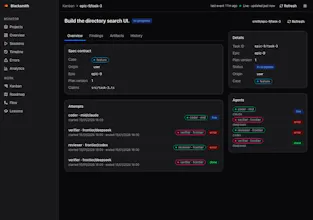
Astra is one of my cross-provider check step. And it really work well beside deepseek.
I'm also expanding blacksmith to codex, as using codex as the core, and Claude & Deepseek are cross-provider judges.