
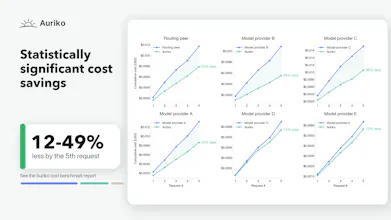
Auriko treats LLM providers as trading venues and arbitrages the spread. Built by ex-quant traders, Auriko’s cost-arbitrage engine calibrates to each user’s request patterns and selects optimized inference paths based on token price, cache behavior, latency, reliability, and request quality. Auriko benchmarks show average 30% cost reduction against industry peers and direct providers. See the source: https://www.auriko.ai/reports/llm-cost-arbitrage




Free Options
Launch Team

Customer.ioAutomate Messaging Everywhere — Startups Get 12 Months Free
Promoted
Optimizing for the expected cost of the full session instead of the cheapest individual request is the interesting part here. Does the routing model also account for context continuity beyond cache economics—for example, provider-specific differences that could cause subtle behavioral drift during a long agent run?
As more routing platforms start optimizing across the same inference providers, do you think the opportunity for cost arbitrage naturally shrinks over time—similar to how financial markets become more efficient—or do you expect new pricing inefficiencies to keep emerging as providers compete?
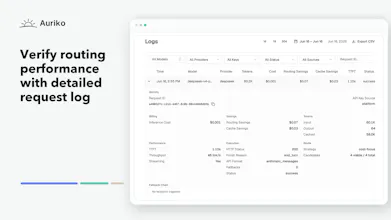
The quality bar for production AI apps is high, so cache aware routing needs good observability.
@nicole_h94 Thanks for the feedback! We have detailed log and audit trial for all llm request and all management api key. The goal is to provider enterprise grade control and observability.
I like that the focus is not just more models, but using the right route for each request.
@tammytan516 Thank you for the support!
The trader instinct behind this makes complete sense to me. Treating those choices like a live market feels like the sort of thing only people who have lived it would ever think to build.
@fanny_guillou Exactly - trading and routing, this is the way how you maximize your token usage!
Love that you guys came from the quant trading world and applied real arbitrage logic to LLM routing instead of just defaulting to whatever provider has the shiniest SDK. The benchmarking transparency page is a nice touch too.
@ece9cgh Thanks for the support! Yes! quant trading and model routing share similar magic - arbitrage and optimize!
This is so good! We are constantly experimenting with different model providers and from testing this out so far, it's worked great, especially compared to other model routers.
@tkeith Thanks Trevor for your support!