
AURELIA Atlas
Knowledge atlas for universe, science, and civilization
14 followers
Knowledge atlas for universe, science, and civilization
14 followers
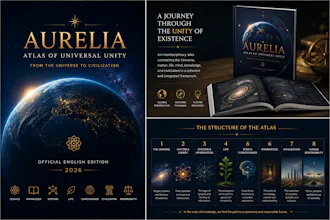
AURELIA — Atlas of Universal Unity is an interdisciplinary knowledge atlas exploring the connections between the Universe, matter, life, consciousness, knowledge, and civilization. Built through the AURELIA framework, this work combines scientific perspectives, philosophical inquiry, and future-oriented thinking into a structured journey from cosmology to human responsibility. The official English edition brings this long-term knowledge project to a global audience.


Free
Launch Team

Framer AI AgentsDesign and publish professional sites with AI
Promoted
This looks like an ambitious project, the kind of slow-burn interdisciplinary atlas I can see myself returning to. Curious how the framework handles the jump from cosmology into consciousness without losing rigor.
@gocemennur76590 Thank you for this thoughtful question. One of the central principles of AURELIA is to preserve the distinction between different levels of knowledge while exploring their relationships.
The Atlas does not treat cosmology, consciousness, and civilization as the same type of inquiry. Instead, it builds a structured path between them: from physical laws and the organization of matter, to the emergence of complexity, life, cognition, and finally human meaning and responsibility.
The goal is not to reduce consciousness to cosmology, but to explore how different domains connect while respecting the methods and limits of each field.
I truly appreciate your question, because this transition is one of the core challenges that AURELIA was designed to address.
A knowledge atlas like this could really benefit from an interactive version online, where readers can click between concepts and see how cosmology connects to consciousness or civilization. A searchable web companion with linked references would make the whole framework so much more navigable and useful for students and curious minds alike.
@enverdonat Thank you for this valuable suggestion. An interactive knowledge environment is indeed one of the natural directions for the evolution of AURELIA.
The Atlas was designed as a structured knowledge framework, where relationships between concepts are as important as the concepts themselves. A digital companion with interconnected references, searchable structures, and interactive exploration could help readers navigate these connections more effectively.
I appreciate your insight, because transforming knowledge from a static format into a living, connected system is one of the challenges and opportunities that inspired the AURELIA vision.
The scope here is genuinely ambitious, and I appreciated how it moves from cosmology to human responsibility without feeling disjointed. Would love to see more interactive elements to complement the dense framework.
@rukiyebfwh Thank you for your kind words. I'm grateful you found the interdisciplinary structure coherent and intentional. Making the framework available in English was an important step, and I hope it helps more people explore and engage with these ideas. I truly appreciate your support.
The scope here is wild in the best way, going from cosmology straight into human responsibility without feeling scattered. Reading even just the early sections gave me new angles on how to connect physics concepts to philosophical ones.
@nuran168993 Thank you for this thoughtful comment. One of the central aims of AURELIA was to explore the connections between different levels of human understanding: from the structure of the universe and the laws of nature, to humanity’s place within existence and its responsibility toward the future.
When we study the cosmos, we are not only studying numbers and equations; we are also approaching the deeper questions that give knowledge its meaning: Where do we stand? What do we do with what we discover? And what responsibilities come with understanding?
I am grateful that you felt the transition between these fields was connected rather than a simple collection of unrelated topics. For me, unity does not mean removing the differences between disciplines, but discovering the relationships between them while respecting the unique value of each one.
Thank you for reading the work with an eye toward the connections between ideas. This kind of dialogue is one of the reasons this Atlas was created.
📚 For those interested in the foundation behind AURELIA — Atlas of Universal Unity, I have also published the official technical documentation of the project.
This document presents the architecture, methodology, and engineering framework behind AURELIA, providing deeper context on how the knowledge system was structured and developed.
Technical Documentation:
https://archive.org/details/aurelia-technical-documentation-v-1.0-2026-1
Thank you for exploring AURELIA and being part of this journey.
This really makes you think about how everything connects, from the cosmos down to daily choices. The structure keeps it digestible even when tackling huge ideas like consciousness and civilization.
@metehanses11655 Thank you, Metehan. Your observation captures one of the ideas I hoped to explore through AURELIA: how larger cosmic perspectives can relate to the way we understand ourselves and our choices. I'm grateful that the structure made these connections accessible. Thank you for taking the time to share your thoughts.