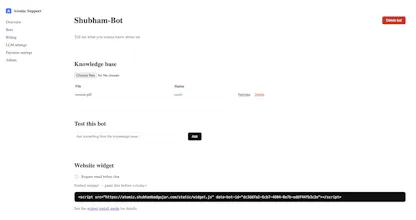
Atomic Support turns your documentation into AI support bots for Discord and websites. Upload PDFs, DOCX, TXT, or Markdown, then deploy a bot that answers only from your knowledge base. Unlike generic AI chatbots, it never invents answers. If the information isn’t in your docs, it simply says it doesn’t know. Perfect for SaaS, education, support portals, and communities where accuracy matters.
No reviews yetBe the first to leave a review for Atomic Support
Maker
📌
Hi everyone! 👋 I’m Shubham, the solo developer behind Atomic Support.
I kept running into the same problem with AI support bots: they confidently answer questions they shouldn’t. For documentation, customer support, and educational content, that’s often worse than saying “I don’t know.”
So I built Atomic Support with a different philosophy.
Instead of using general AI knowledge, every response is grounded only in the documentation you upload. If the answer isn’t in the knowledge base, the bot simply says it doesn’t know.
Current features:
* 📚 Upload PDFs, DOCX, TXT, and Markdown
* 🤖 Discord bot
* 💬 Website chat widget
* ✅ Answers only from your documentation
* 🚫 No hallucinated answers
* 📊 Usage dashboard and conversation history
* 📧 Optional email capture before chat
* 🆓 Free plan to get started
I’d really appreciate your feedback. I’m especially interested in hearing:
* What integrations would you want next?
* What would stop you from using this today?
* What features would make it an instant yes?
Thanks for checking out Atomic Support!
Report
If this uses an LLM to power it, how can we be sure it won't hallucinate answers?
Also here is a free QR code you can use if you'd like that goes to your website:
Report
Maker
@mjohnson42 LLMs can hallucinate, so we don’t rely on the model alone. We reduce that risk by grounding responses in trusted data, validating outputs, and using guardrails. The goal isn’t to claim hallucinations never happen, but to make them rare, detectable, and handled appropriately.
Thanks i will definitely use use it its cool tool
Report
Maker
📌 A lot has changed since I launched Atomic Support
When I launched Atomic Support, it was mainly a simple idea: support bots that answer only from your documentation.
Since then, I’ve been building almost every part of the support workflow around that core.
What’s new:
🤖 Grounded AI • Strict Q&A or a more conversational support mode • Source citations • “I don’t know” when the knowledge base doesn’t have the answer • Self-improving knowledge base from unanswered questions and resolved tickets
🎫 Support operations • Ticketing and assignment • Unified customer profiles across channels • Business hours / offline mode • Reply directly from one dashboard
📈 Sales • Lead detection and 0–100 lead scoring • CRM/webhooks • Booking handoffs • Lead alerts
🧠 Intelligence & automation • Conversation summaries, intent, and sentiment • Analytics and weekly digests • Automations for tagging, routing, priority, and Slack notifications • Team seats and roles
The original idea hasn’t changed: AI support should be grounded in what the company actually knows, not what the model happens to know.
I’ve just expanded what the agent can do around that core.
I’d love to hear from people who run support or SaaS teams: what’s the biggest thing still missing from this workflow?
If this uses an LLM to power it, how can we be sure it won't hallucinate answers?
Also here is a free QR code you can use if you'd like that goes to your website:
📌 A lot has changed since I launched Atomic Support
When I launched Atomic Support, it was mainly a simple idea: support bots that answer only from your documentation.
Since then, I’ve been building almost every part of the support workflow around that core.
What’s new:
🤖 Grounded AI
• Strict Q&A or a more conversational support mode
• Source citations
• “I don’t know” when the knowledge base doesn’t have the answer
• Self-improving knowledge base from unanswered questions and resolved tickets
🌐 Omnichannel
• Website widget
• WhatsApp
• Telegram
• Discord
• Email
🎫 Support operations
• Ticketing and assignment
• Unified customer profiles across channels
• Business hours / offline mode
• Reply directly from one dashboard
📈 Sales
• Lead detection and 0–100 lead scoring
• CRM/webhooks
• Booking handoffs
• Lead alerts
🧠 Intelligence & automation
• Conversation summaries, intent, and sentiment
• Analytics and weekly digests
• Automations for tagging, routing, priority, and Slack notifications
• Team seats and roles
The original idea hasn’t changed: AI support should be grounded in what the company actually knows, not what the model happens to know.
I’ve just expanded what the agent can do around that core.
I’d love to hear from people who run support or SaaS teams: what’s the biggest thing still missing from this workflow?