Astra Security helps modern enterprises find and fix vulnerabilities before attackers do.
Astra is a leading penetration testing company that provides PTaaS and continuous threat exposure management capabilities. Our comprehensive cybersecurity solutions blend automation and manual expertise to run 15,000+ tests and compliance checks, ensuring complete safety, irrespective of the threat and attack location.
This is the 3rd launch from Astra Security. View more
Astra Autonomous Pentest
Launched this week
AI agents that find, validate, and fix every vulnerability
Astra Autonomous Pentesting makes self-healing software the new standard, a category we’re defining after 8 years and 5,000+ real-world pentests. An army of offensive pentesters and bounty hunter agents that discovers complex chained vulnerabilities, an independent validator layer drives false positives to near-zero, and AI-fix agents deliver remediation as native Cursor, Copilot, and Claude Code prompts. The reactive pentest era is over.
Hi @mohit_kalshan , Yes, Astra’s discovery + continuous AI-powered offensive DAST scanning helps find the shadow and zombie endpoints, especially those that pose real risk 🛡️
I'm Shikhil, the founder of Astra Security. I did my first pentest 15+ years ago and have been obsessed with offensive security ever since.
Over the years, we built a PTaaS platform, a DAST scanner, API Security platform, a Cloud Vulnerability Scanner - and discovered tens of millions of vulnerabilities along the way. But one belief stayed constant through all of it: business logic vulnerabilities would never be discovered autonomously. Ever.
AI just shattered that limit. And nothing has excited me like this in 15 years of being in infosec. 🤯
So we built Astra Autonomous Pentesting. Not a smarter scanner. An army of AI agents that owns the full pentest cycle:
🔍 Discover - Offensive agents built on insights from 5,000+ real-world pentests hunt complex, chained vulnerabilities.
💥 Exploit - Agents chain and exploit findings to prove real-world impact, not flag theoretical risks.
✅ Validate - An independent validator layer drives false positives to near-zero.
🔧 Fix - AI-fix agents that deliver tailored remediation right in your Cursor, Copilot, and Claude Code.
The full cycle. No handoff. No report sitting in someone's inbox. Software that heals itself.
This isn't about replacing pentesters 🙏 Let AI own the grunt work - the cookie flags, the report writing, the endless threat modeling sessions. Let pentesters do what they love: chaining complex vulnerabilities, getting deep into a system. Pentesters at Astra, are central to everything we build. Now AI is their most powerful ally, not their replacement.
We call this the era of self-healing software. And we're just getting started. Would love your questions, brutal takes, and your support today. 🚀
Looking forward to help you with your next Pentest!
Whoa! I saw this on the leaderboard and immediately sent it to a security testing agency I have been working with. They asked me to pose this question to you... what specific approach or training data enables these agents to understand context-specific business rules that vary across different applications?
To answer your question, our agent crawls your application, maps how it actually behaves, and builds test scenarios specific to your business logic. Our own DAST engine also feeds in as an input. The findings add additional context that sharpens our scenarios, layering signal on signal. Those feed into our Attack AI engine which probe with intent, not just generic payloads. Then it switches into bounty hunter mode, skipping the checklist, going straight for the highest-value targets: privilege escalation, auth flaws, logic bypasses.
Report
@shikhilsharma Congrats on the launch! How do you handle the edge case where AI agents chain vulnerabilities across business logic boundaries that require context outside the system (e.g., a workflow that's technically valid but violates a specific compliance rule or business policy)? Do you have a feedback loop where human pentester insights on these edge cases automatically update the agents' chaining logic, or is that still manual?
@swati_paliwal Great question, the agents build a contextual map of your application's intended behaviour before chaining, testing access control violations, privilege escalation paths, and business logic flaws against the application's own model. External compliance rules that live outside the system (a regulatory policy, a business process document) need to be briefed in via the scan prompt, the same way you'd brief a human pentester.
On the feedback loop: validated findings and human-flagged edge cases do feed back into the agents' chaining logic, but the latency isn't real-time yet. It's a structured review process, not an instant update. That's something we're actively working to tighten.
The 90% that's technically testable, the agents handle autonomously. The 10% that requires external context, compliance rules, policy documents, and business process knowledge still needs a human at the briefing stage. We think that's the right division of labour, not a limitation to hide.
Report
@shikhilsharma congrats on the launch Shikhil, this looks cool. how do you control automated remediation?
@zolani_matebese Astra does not auto-remediate. The agents find vulnerabilities, prove them, and validate them, but nothing in your codebase is touched without a human making that call.
What we do is eliminate the friction between finding and fixing. Once a vulnerability is confirmed, AI fix agents read your codebase and generate the exact fix for your implementation. That fix lands in your developer's IDE via MCP: Cursor, Copilot, or Claude Code. The developer reviews it and applies it.
You mention AI agents can autonomously discover, exploit, validate, and even help fix vulnerabilities. What's the biggest limitation where human pentesters still consistently outperform your AI today?
@truemax Honestly, creative social engineering and highly contextual business logic flaws require a deep understanding of a specific industry's workflows. That is exactly why our top tier combines AP with human pentesters; the AI handles breadth and speed, humans bring the intuition.
Report
My congrats! Does the autonomous pentest cover authenticated flows out of the box, or does that require manual configuration? Asking because most scanners struggle with post-login attack surfaces.
@igorsorokinua Great question, and you are right that most scanners completely fall short here.
Astra's Autonomous pentesting handles authenticated flows out of the box. You provide login credentials and optionally a login recording for complex flows like MFA or CAPTCHA, and the AI agents log in as multiple user roles to crawl and test everything behind the login wall.
This is actually where AP finds the most critical vulnerabilities, things like IDOR, privilege escalation, and BOLA that only surface in authenticated sessions.
Report
Congrats on another launch! Was wondering... discovering and validating is one thing, but you're actually chaining auth bypasses and privilege escalation against a live target to prove impact. That's a real agent taking real destructive actions. What happens the first time it escalates into something it can't cleanly roll back, mid-run on someone's prod?
Our AI operates with strict boundaries, using a read-only payload mindset to intelligently demonstrate impact and chain logic flaws without triggering destructive mutations or configuration writes in production.
For the Validator layer, we actively simulate exploit paths rather than running irreversible exploit code, allowing us to mathematically verify the risk while keeping your state completely clean.
Congrats on the launch! Secure web apps is what we need today.
Does your project work with source code only? (to my understanding, in the CI pipeline) Can it also analyze, for example, minified or obfuscated client code on a live or sandboxed website?
No source code needed. You point Astra at a live or sandboxed URL and the agents work from the outside, the way a hacker would.
On minified and obfuscated client code, the agents don't analyse the bundle statically. They interact with the running application, observing API calls, endpoint behaviour, and server responses.
CI/CD integration works via API, trigger a scan against your staging environment before every deploy and get findings before anything reaches production. The only thing source code is used for is the fix delivery layer, where agents read your codebase to generate contextual fixes. The pentest itself needs nothing beyond a URL and user credentials.
@viranchi_dadhichh super insightful, thank you! One more question – will your agents go deeper and, most importantly, to what extend deeper in the event when they'll find out that the http/websocket connection of the web app to the server is encrypted and the web app's code itself is obfuscated?
@nikitaeverywhere The product runs as an authenticated surface. Dedicated testing credentials are commissioned so the agents can exercise every interaction flow and surface from inside a real session.
Because the testing happens within that, transport encryption doesn't impede the agents at all; they pentest the application normally. When it comes to client-side code obfuscation, we have dedicated strategies for analysing those bundles efficiently to surface issues.
@viranchi_dadhichh thanks a lot, now I think I have a good understanding of your product.
On a transport encryption, I meant that the transport layer is obfuscated on the application level, so that even authenticated agent will only see unreadable bytes traveling over the network, and wondered how much of useful findings your product can produce in this case.
Report
Love the validation layer approach. How do you keep AI fixes safe in high-sensitivity environments—do you require human approval or enforce policy constraints before any remediation prompt gets applied?
@leventbuilds We never execute fixes directly; we provide the precise code blueprint to your dashboard, keeping the ultimate "merge" button firmly in human hands. Our AI operates strictly as an advisor under tight policy guardrails, allowing your engineers to review, test, and safely apply the contextual fixes themselves.
Report
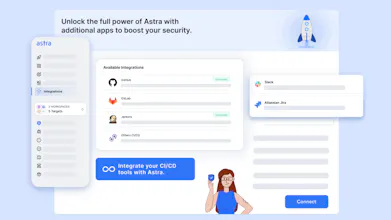
Hey team! What's the integration story with GitHub Actions / GitLab CI? Would love to trigger a scan on every PR merge.
@mikhail_prasolov Astra integrates seamlessly with GitHub Actions and GitLab CI, allowing you to automatically trigger automated scans right on every PR merge.
Report
What if I’m a developer and need to quickly audit a client’s website just by providing the site URL? Is that possible? Does it generate a report after the audit? That would be very helpful for selling my services.
@natalia_iankovych That is precisely the use case: point Astra at the URL, and the agents do the rest, returning a full report with validated findings, steps to reproduce, and contextual fix recommendations your client can actually act on.
Astra Security
Hi @mohit_kalshan , Yes, Astra’s discovery + continuous AI-powered offensive DAST scanning helps find the shadow and zombie endpoints, especially those that pose real risk 🛡️