
Arcovia
Architecture Intelligence for React & Next.js Projects
19 followers
Architecture Intelligence for React & Next.js Projects
19 followers
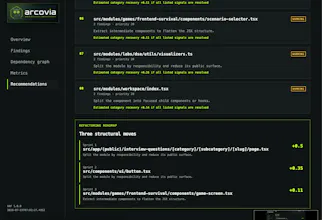
Arcovia goes beyond linting by analyzing the architecture of React and Next.js applications. It builds a dependency graph, evaluates deterministic architecture rules, calculates an explainable Architecture Health Score, and generates an interactive HTML report with hotspots, findings, maintenance burden, and actionable recommendations. Built for teams that want to understand, measure, and continuously improve their architecture.



Hey Product Hunt! 👋 I'm Ghazi, the maker of Arcovia.
Arcovia started as a weekend project for the OpenAI Build Week Hackathon. I began building it on Friday evening with one goal: create a tool that helps developers understand the architecture of their React and Next.js applications, not just their code quality.
Most tools tell you what is wrong. I wanted to answer why your architecture received a particular score and what you should fix first.
Arcovia performs deterministic analysis by parsing your project, building a dependency graph, and evaluating architecture rules to generate an interactive HTML report with:
✨ Architecture Health Score
📊 Dependency Graph
🎯 Hotspots & Actionable Findings
📈 Explainable Scoring & Maintenance Burden
One of my favorite parts of this project is how it was built. GPT-5.6 and Codex became my engineering collaborators, helping me iterate on the architecture, scoring engine, reports, and developer experience throughout the weekend. I also used ChatGPT Images to design the branding, owl mascot, logo, and launch assets.
Arcovia is 100% open source, and this is just the beginning. My vision is to make it an architecture intelligence platform that helps teams understand, measure, and continuously improve their codebases over time.
If you have a React or Next.js project, I'd love for you to give it a try. Your feedback on the architecture score, findings, and overall experience will help shape the roadmap.
Thank you for checking it out, and I'm happy to answer any questions! 🚀
Appreciate if you ⭐️ Github repo: https://github.com/gkhan205/arcovia
Honestly this sounds super useful for our Next.js app, we have been wrestling with messy dependency layers for a while. One thing that would really help is letting teams define custom architecture rules on top of the built-in ones, basically a config file where we can flag something like "no component under src/components should import from src/server". That way Arcovia fits whatever shape your codebase actually needs instead of only the defaults.
@hatunnevruz That's a pattern I keep hearing, several people have asked for exactly this kind of custom rule support. A config file for import boundaries, like blocking src/components from importing src/server, is very doable. Would you want just import-path rules, or also things like max coupling per module, file size limits, that kind of thing?
@hatunnevruz Thanks again for the suggestion! I really liked the idea and decided to prioritize it.
I've just released Arcovia v0.2.0 with support for custom policy rules, so teams can define architecture rules that fit their own standards instead of relying only on the built-in ones.
I also launched the documentation site: https://arcovia.ghazikhan.in
I'd love to hear what you think and whether there's anything else you'd like to see.
Hey, this looks nice. Just wondering any plan to expand it to more backend frameworks like Nest JS? Backend is where all the business logic stays and it becomes the bottleneck very quickly if left unattended
@bhupesh_gupta Thanks! Yes, it's definitely on the long-term roadmap. I started with React and Next.js because that's where I wanted to validate the architecture analysis engine first. Once the core engine is mature, I'd love to expand Arcovia to backend frameworks like NestJS, where architectural boundaries, dependency direction, and module relationships become even more critical. Really appreciate the suggestion!
@ghazi_khan great to hear that, though I love react side but main work goes on backend side and will eagerly wait for such capabilities there. Thanks for your efforts.
@bhupesh_gupta Thanks so much, Bhupesh! I really appreciate the encouragement. Backend support is definitely something I want to tackle once the core engine is battle-tested. NestJS is at the top of that list, and feedback like yours helps shape the roadmap. Hope to have you try it when that day comes! 🙌
Ran it on a pretty messy Next.js codebase and the dependency graph alone made it worth it, you can actually see where stuff is tangled. The health score is a nice touch too, feels honest instead of just nitpicking.
@meral25451 Really glad the dependency graph helped surface the tangled parts, that is exactly the use case I built it for. What kind of repo was it, monorepo, size roughly, App Router or Pages Router? Trying to build a test corpus of real messy codebases to sharpen the rules.
Love that you're going beyond linting, the architecture health score concept is genuinely useful. One thing that would make this even better for my team is a way to set custom scoring weights per project, like letting us prioritize security hotspots over duplication for a healthcare app versus a marketing site.
@dceteli47457 That's a great point, security-critical vs marketing-site is a real difference in what should matter most. Right now the weights are fixed defaults based on general best practices. Configurable weighting per project is on my radar, curious how your team would want to define that, per-project config file, or something set once at the org level?
Ran it on a fairly messy Next.js codebase and the hotspots view immediately showed a couple of cycles we had been ignoring for months. The explainable health score is a nice touch too, makes it easy to share with the team without sounding preachy.
@zeynepakj0 That's a great way to put it, the score doing the arguing instead of you. Curious how big the team is and whether this is something you'd want running automatically on a schedule, or just something you pull up before specific conversations like retros.
Took it for a spin on a messy Next.js codebase and was surprised how the dependency graph actually surfaced cycles we had ignored for months. The architecture health score is a nice anchor for retro conversations.
@tuana1214594 Good to hear it's useful for retros, that's actually a use case I hadn't planned for but makes a lot of sense. Did the team end up scheduling a fix for those cycles, or is it still sitting in the backlog for now?