No reviews yetBe the first to leave a review for AI M0V1E
Maker
📌
AI M0V1E: Building a Mobile Streaming App with AI Agents
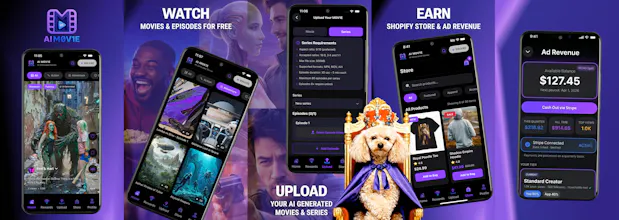
In late 2025, I set out to build the consumer destination for AI-generated movies — a mobile platform where viewers binge episodic series, creators generate or upload from their phones, and advertisers run self-serve video campaigns.
The problem I was trying to solve was a hub for AI Filmmakers to form a community and monetize from their work since there were many platforms for generating movies, but few to monetize and distribute them.
AI M0V1E enables creators to monetize their content by offering simple publishing, real-time analytics, and direct ad revenue sharing upon reaching 500 followers and 1,000 views. The platform also integrates with Shopify, allowing creators to sell products directly through videos while retaining 95% of sales, with only a 5% fee.
I didn't use AI as autocomplete. I used Cursor agents as senior engineering partners: researching vendor APIs, proposing architecture, writing Postgres migrations, shipping mobile screens, and iterating through tests. Within days of my first commit (October 2025), I had a working MVP: auth, a video feed, uploads, and streaming playback.
As the product grew — payments, moderation, ads, commerce — I formalized "Engineers." In March 2026 I shipped the Bug Engineer system: CI that type-checks mobile and backend, runs Jest, audits security, smoke-tests Docker builds, and auto-triages failures to GitHub issues. Cursor rules and Bugbot PR policies enforce error handling, RLS, and server-side payment security.
Agents also guided stack decisions. Supabase became auth, PostgreSQL with Row Level Security, and storage. Render hosts the Dockerized Node/Express API with staging, production, secret groups, and auto-deploy — infrastructure for Mux uploads, Stripe webhooks, and AI generation jobs without running Kubernetes alone.
By March 2026 the app was store-ready: series-first UX, memberships, credits, Ads Manager, moderation, and accessibility compliance. I launched on Google Play first (May–June 2026), then the iOS App Store through TestFlight, Fastlane, and iterative Apple review — both stores shipping 2.0.x in Q2 2026.
The lesson isn't "AI wrote my code." One builder with the right agent workflow can ship what used to require a small team — if you own product vision, review security-sensitive paths, and turn agents into systems, not shortcuts.