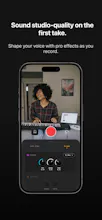
Built for content creators and musicians, AetherCam lets you shape your sound on the fly. Whether you’re filming an acoustic performance, a vocal take, or a quick social post, your audio becomes part of the performance itself. AetherCam turns your iPhone’s microphone into a live audio workstation. Open the FX Rack and apply studio-quality effects in real time: add reverb to give your guitar space, dial in delay for depth, sculpt your tone with a 3-band EQ, or tighten things up with a compressor
No reviews yetBe the first to leave a review for aetherCam
Maker
📌
Audio has always been an integral part of my life. From being obsessed with music at an early age, to then picking up my beloved instrument (guitar), which is still my greatest passion 17 years after I first played it, sound has always followed me. Over time, that fascination with sound evolved beyond music and into the engineering aspect of audio. After working for a startup that dealt with exactly that, I realized that audio is one of the most fascinating domains one can work in. My latest app, AetherCam, is a result of all of those experiences.
Most video recording tools prioritize what we see. AetherCam however, is rooted in the belief that sonic quality is just as important as the visual experience, because sound doesn’t just accompany a moment, it can sometimes completely transform how we experience it.
So, what is AetherCam about?
1) Real-time audio monitoring & processing
Monitor input levels as you record. Track loudness target. Adjust microphone gain on the fly. Apply high-quality audio effects in real time.
Need more space? Add reverb.
Need clarity? Shape the mids with EQ.
2) Dual-track recording
Every recording captures both the processed signal and the original raw microphone input.
If you don’t like the live processing, you can always fall back to the untouched track.
Or re-apply effects later.
Or export it completely clean.
No irreversible decisions.
3) 2× Mode
For creators who want to move fast.
Tap once to record in 2× mode and naturally skip filler while speaking. It’s a simple way to tighten content at the source, before you even enter post-production.
This is a really exciting approach for content creators who care as much about sound as visuals. The dual-track recording + real-time FX workflow is clever — it gives creators flexibility while keeping the recording process fast and intuitive.
One thing I’d be curious about: how does the learning curve feel for first-time users who aren’t familiar with EQ, compression, or reverb? A tiny, built-in “guided FX mode” could make it feel even more approachable without diluting control for advanced users.
If you’d like, I can put together a short audit with 3–4 tactical suggestions to improve onboarding, highlight features, and potentially increase daily engagement. Would be happy to share!
Report
Maker
@olajiggy321 Hey! thank you for great questions and feedback :) In the next version that I already have in the works, the learning curve for first-time users will be significantly easier. It's been something that I also had in mind when working on AetherCam, but opted to first test the general idea out and only later embellish it. Thanks!
@januszpdev
This is a really exciting approach for content creators who care as much about sound as visuals. The dual-track recording + real-time FX workflow is clever — it gives creators flexibility while keeping the recording process fast and intuitive.
One thing I’d be curious about: how does the learning curve feel for first-time users who aren’t familiar with EQ, compression, or reverb? A tiny, built-in “guided FX mode” could make it feel even more approachable without diluting control for advanced users.
If you’d like, I can put together a short audit with 3–4 tactical suggestions to improve onboarding, highlight features, and potentially increase daily engagement. Would be happy to share!
@olajiggy321 Hey! thank you for great questions and feedback :) In the next version that I already have in the works, the learning curve for first-time users will be significantly easier. It's been something that I also had in mind when working on AetherCam, but opted to first test the general idea out and only later embellish it. Thanks!