
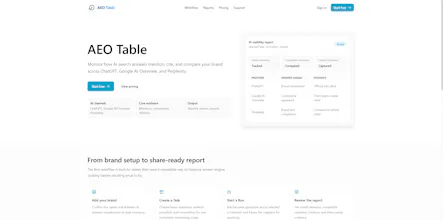
Track how AI answers mentioAEO Table scans your domain and shows whether ChatGPT, Perplexity, Google AI Overviews, and Gemini cite your brand. Get your AEO Score, track competitor AI citations, and see exactly where you appear — and where you're invisible. Built for marketing teams who need to know how AI answers talk about their brand, not just their Google ranking.
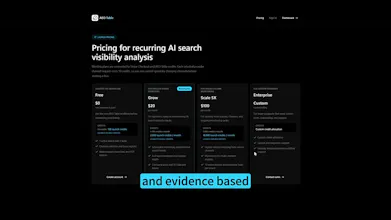


Free Options
Launch Team / Built With


Framer AI AgentsDesign and publish professional sites with AI
Promoted


Hey Product Hunt!
We built AEO Table because we were tired of guessing whether our content was being cited by AI search engines.
Traditional SEO tools tell you about Google rankings — but who tells you about ChatGPT, Perplexity, and Google AI Overviews?
With AEO Table you can:
1. 🔍 Scan your domain and see your AI visibility score instantly
2. 📊 Track competitor AI citations — who's getting cited and why
3. 📝 Get optimization playbooks — what to create to rank in AI answers
4. 📈 Monitor growth — watch your AI citation count climb
We're offering a special 30% discount for the PH community .
We'd LOVE your feedback on the visibility dashboard.
What would make this a daily tool for your team?
— The AEO Table Team
Any case studies? I'd love to see an example of a brand that improved their AI citations using AEO Table.
@jiayang_zhang1 Great question! We are currently putting together detailed, long-term case studies, but we’ve already seen some exciting early results.
For example, we noticed a brand that was completely invisible in Perplexity for their core keywords because their pricing page structure confused the LLM. By using our Optimization Playbook, they updated their schema and content layout—and within days, they started appearing as a top citation in AI answers.
As someone who’s always messing with AIGC prompts, this hits close to home. It’s wild to finally see exactly where and how AI picks up on content/brands.
Thanks@weining_liao
That's exactly the feeling we had when building this — we kept prompting ChatGPT with the same questions over and over, trying to figure out WHY some brands showed up and others didn't. The 'aha moment' for us was realizing that AI citation patterns are actually trackable (and optimizable), not just random.