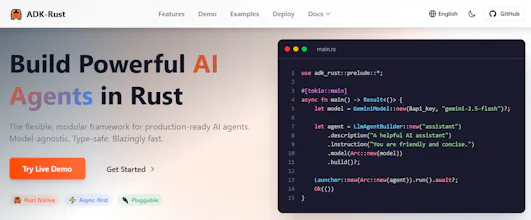
The flexible, modular agent framework for production-ready AI agents. Model-agnostic. Type-safe. Blazingly fast. Build LLM agents, workflows, and multi-agent systems in Rust.
No reviews yetBe the first to leave a review for ADK-Rust
Maker
📌
Hey Product Hunt 👋
Over the last year I’ve been shipping AI agents into real production systems and writing The Complete AI Blueprint, where I broke down pretty much every major agent framework out there. Seeing them side by side made one thing painfully clear: every tool forces a trade-off.
If it’s powerful, it’s heavy or hard to reason about.
If it’s simple, it’s rigid or locks you in.
I tried and studied a lot of them:
LangChain — flexible, but big memory footprint and slow cold starts
LangGraph — strong patterns, steep learning curve
OpenAI SDK — clean, but tightly coupled to one provider
Google ADK — very opinionated, solid guardrails, but rigid outside its happy path
Autogen — genuinely good agent design ideas, but discontinued by Microsoft, which makes it risky to build on
Each had ideas worth learning from. None felt like something I could confidently ship and scale long-term.
So instead of stacking more abstractions on top, I built what I actually needed: ADK-Rust.
Rust wasn’t about novelty—it was about control. When Discord rewrote their voice backend in Rust, they cut CPU usage by ~75%. That’s the kind of predictability you want for agents that run continuously, speak in real time, or sit on the edge.
What ADK-Rust looks like today:
-Fast startup and low memory (tens of MB, not hundreds)
- No provider lock-in (OpenAI, Anthropic, Gemini, DeepSeek)
- Real-time voice agents (OpenAI Realtime + Gemini Live)
- Stateful workflows inspired by LangGraph, without the overhead
- A single small binary you can actually deploy
- It’s built for teams where “just use Python” eventually becomes a liability:
real-time systems, edge deployments, regulated environments, performance-sensitive workloads.
If you want to try it:
cargo add adk-rust
cargo run --example quickstart
What we would really love is your feedback:
- Which agent patterns are you struggling with right now?
- What’s been the biggest blocker to using Rust for AI?
- What should I focus on next?
We think you’ll love ADK-Rust because:
- It’s built for production performance
Fast startup, low memory, streaming by default, and a single small binary you can actually deploy.
- It grows with you instead of boxing you in a single platform
Start simple, add workflows, graphs, voice, tools, and memory as needed—no rewrites, no lock-in.
- It’s easier to reason about when things get complex
Strong typing, real examples, and fewer hidden abstractions mean less guesswork and fewer surprises.
Best
James