I m building Termy, a native macOS workspace for SSH and server operations.
For people working with several hosts, what still pulls you back to a terminal plus separate tools?
What context do you lose after an incident?
What makes multi-host actions feel unsafe?
Which client do you use now, and what would genuinely make you switch?
Blunt answers are welcome, including reasons you would not use Termy.


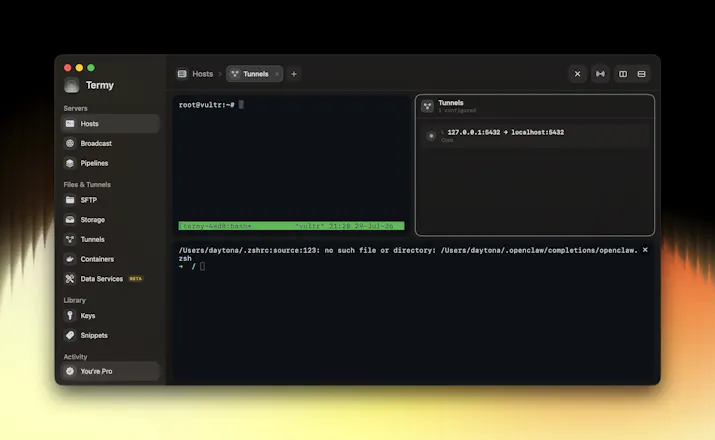


Hey Product Hunt. I'm the solo maker of Termy. I spent the last six months building a native macOS SSH client because every option I used was either Electron or a generic terminal with SSH bolted on.
The problem I kept hitting: you connect to production, then you still run htop, df, ss, docker ps before you dare type anything. I wanted that picture at connect time, with nothing installed on the server.
Termy is Swift/SwiftUI end to end, including the terminal emulator (not xterm.js, not a WebView) and a Mosh client written in Swift. On connect it builds an agentless Host X-ray: disks, processes, ports, services, containers, recent activity. Playbooks run a documented Ansible subset through Termy's own SSH engine and fail closed. Unknown steps never reach the host. Tunnels restore after a cafe Wi-Fi drop or a cold launch. Keys live in the Keychain, or in the Secure Enclave with Touch ID on every signature.
I started this as "make SSH feel like a Mac app." It turned into a workspace around that first snapshot, because a pretty terminal still leaves you blind.
Free tier with host/key limits. 7-day Pro trial starts after your first successful connection. Then $3.99/month, $24.99/year, or $39.99 lifetime.
https://termyapp.com
If you SSH into prod from a Mac: would you trust that snapshot enough to skip the first five commands?
I'll be here answering questions all day.