

Supply Tally
Track supplies without complex inventory software
5 followers
Track supplies without complex inventory software
5 followers
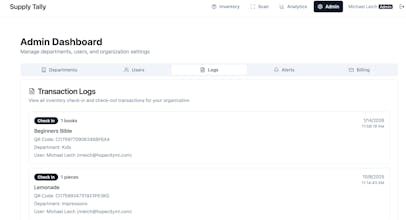
Many organizations rely on shared supplies — food, paper goods, office items, event materials - but tracking them often falls apart over time. SupplyTally is a lightweight cloud tool designed to answer simple questions: -What do we have? -What’s running low? -What gets used most often? It’s built for teams with rotating staff or volunteers who need something easy to update and easy to understand. No warehouse workflows. Just practical tracking that fits real-world operations.




👋 Hi everyone, I’m the maker of SupplyTally.
I built this after seeing many teams struggle with tracking shared supplies - spreadsheets drifting out of date, knowledge living in one person’s head, or discovering shortages right before events.
SupplyTally is intentionally simple and opinionated. It’s not trying to be a full inventory system. It’s meant to help teams stay aware of what they have and what they’re using.
I’m especially interested in feedback from nonprofits, churches, or small teams:
-Does this feel useful?
-Is it too simple?
-What’s missing for your use case?
Thanks for taking a look. Happy to answer questions.
@michael_leich
Automating the shift from scattered spreadsheets to simple, shared supply tracking is a genius utility. It turns inventory management from an organizational chore into a lightweight, volunteer-friendly system.
A key growth question: For a tool that delivers maximum value when adopted by entire teams with rotating staff, what's the primary path to scale—is it bottom-up through communities of nonprofit and volunteer coordinators, or top-down by partnering with associations and platforms that serve small operations and event organizers?
@olajiggy321 Thank you for the question! In my opinion the key path to scale is bottom-up with the volunteer coordinators. Really focusing on the people who are managing the spreadsheets already and can use the benefit of a central, shared supply tracker.
@michael_leich
Makes sense — starting with the volunteers already in the spreadsheet trenches is the right entry point.
I have a straightforward idea you could try on your own — happy to send it your way if useful.
Where’s best to share it — Twitter, LinkedIn, or email?