
An AI native user today copy-pastes prompts across a dozen apps. It's a broken experience for any kind of meaningful work. Every new chat box collapses context to zero. Slashspace solves that with an AI canvas where AI lives on the canvas, and you can run many chats as nodes. The canvas becomes the context space, and all the agents can see each other. Canvas is stored as files on your computer. Built with 1600 power users for over 1.5 years, we're the most mature canvas AI on the market.


Free Options
Launch Team / Built With


Framer AI AgentsDesign and publish professional sites with AI
Promoted


 Poppy AI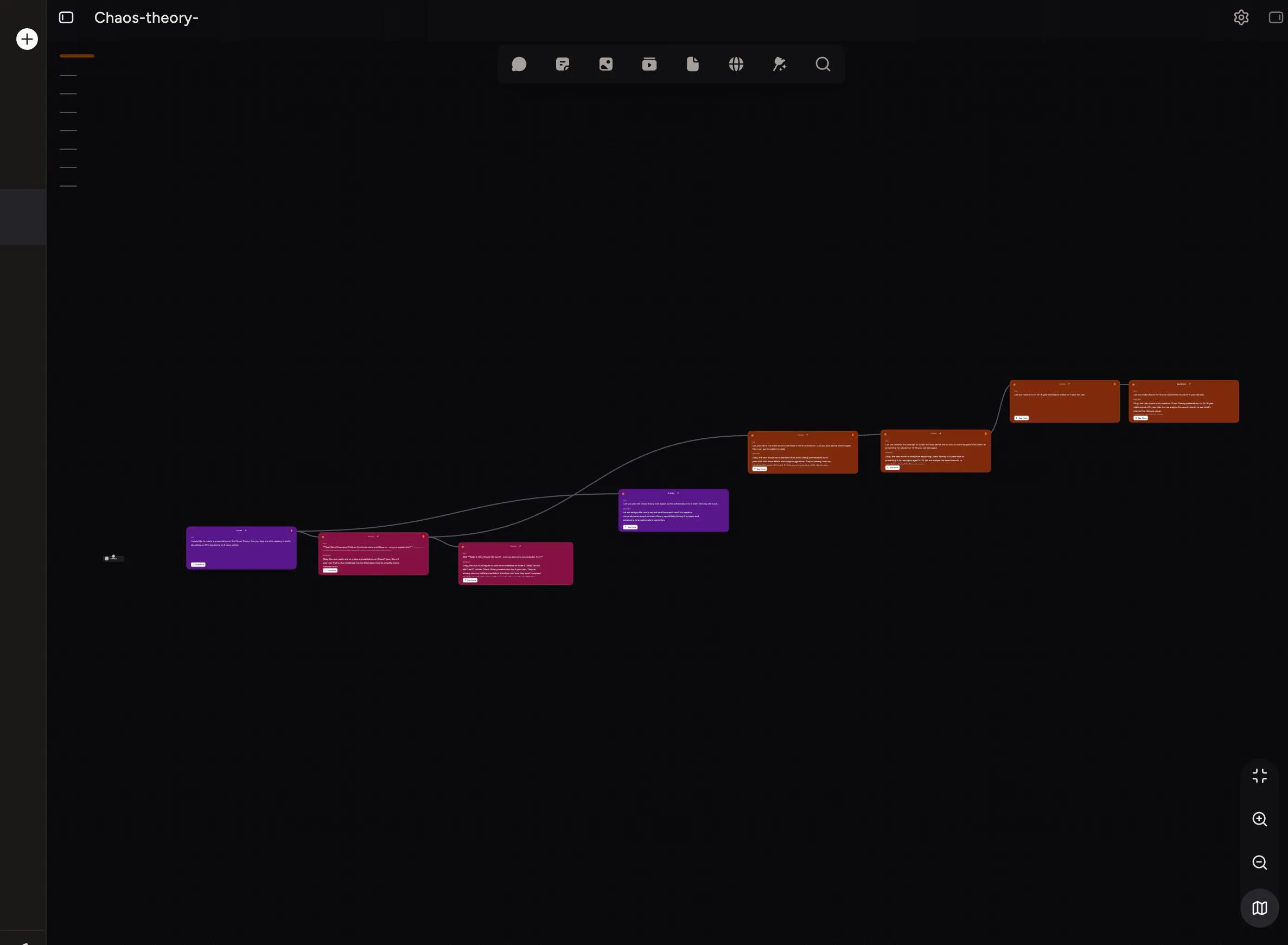
Slashspace AI
Hello, Product Hunt! 👋
After years of being a designer and developer, AI came into my life and changed everything. It gave me the confidence to go after my most ambitious products. But chat boxes and fragmented contexts across many apps aren't built for complex work.
As a founder, developer, and marketer, I'm a generalist. I work on many things that don't fit into single sessions. I needed a new kind of interface that works along with my brain, not against it.
Slashspace is a canvas-first interface for AI. It's a desktop app that stores everything locally. For each complex problem, you create a new space. Add all your documents to this space, connect to all the MCP tools you want, and run many agents.
All the agents see everything in the space. Run multiple agents in parallel, ask them to derive context from one another, and direct them to solve problems that you wouldn't have been able to do in a linear app.
Slashspace is the 10x generalist's interface AI interface. It can write, delegate, plan, code, create, and do many things. If ChatGPT raised the floor on who can build things, Slashspace is meant to raise the ceiling on what's possible for ambitious people and teams to build in the AI-era.
Hope you all enjoy using the app, and share your feedback.
Best
Praneeth
@praneethpike the 'all agents see everything' part is shared read context — that's the tractable bit. where parallel agents actually fall over is concurrent writes. we run a few against the same repo and ended up serializing the write step to one at a time, reads shared, just so they don't clobber each other.
whether canvas nodes can write the same space at once or it's single-threaded under the hood is the thing that'd tell me how far this scales.
@praneethpike Congrats on teh launch Praneeth. Was going to ask about shared context and then answered my own question with the "one context per goal". Makes a lot of sense.
@praneethpike I haven't tried Slashspace yet BUT I just HAD to say that I love what you said about AI, I feel the EXACT same way about AI!! I read a paper called, "Cybords, Centaurs, and Self-Automators: The Three Modes of Human-GenAI Knowledge Work and Their Implications for Skilling and the Future of Expertise" that seriously blew my mind. I am a generalist as well and found the ultimate tool in AI. What was once something I had to create a whole team for is now something I can create in an hour! (long story short I love your outlook on things, great minds think alike!)
Slashspace AI
@shannon_byrne Aww! thanks for such a thoughtful comment! Love to get your feedback using the app :)
The shared-context canvas is a clever way to run agents side by side, this is close to how I think about running multiple coding agents at once. When you've got a bunch of nodes going, how do you keep track of which agent did what without it turning into a wall of boxes?
Slashspace AI
@ianhxu the node title generally solve this problem. And all the new nodes will get a metadata context of the graph so the new nodes will know what they're asking for
Canvas approach makes sense for deep work. How does it handle conflicting outputs when running multiple AI models in parallel?
Slashspace AI
@dhiraj_patel5 the models get a graph of and metadata about the nodes. so the frontier models are smart enough now to tell that another similar generation was done in a different node, and you're probably wanting something different
Slashspace AI
@dhiraj_patel5 the agents can see a context graph, metadata of the nodes, and the latest models are smart enough to know that we're repeating or something's already been asked. so the second response will be built on top of that.
"Every new chat box collapses context to zero" is painfully accurate — I bounce between a dozen chats building my app and lose the thread constantly. Making the canvas itself the shared context where nodes can see each other is a clever fix; how do you keep the context window manageable once a canvas grows to dozens of nodes?
Slashspace AI
@lennoxbeflying the latest models are smart. we give them a context graph and metadata of the canvas. so they'll act accordingly either to build on top of previous generations or sometimes point you to a previous post
SonOf
Chat is great for quick turns but falls apart on work that spans days — a canvas you can lay out and return to fits that far better. How does Slashspace keep context coherent across a sprawling canvas: one model context, or retrieve regions on demand?
Slashspace AI
@oleksii_sekundant the new models get metadata of the canvas and existing nodes. so when you ask a new node about something, they retrieve context that's already on the canvas. unless you tell it do different things
Congrats on the launch. Canvas as shared context makes a lot of sense for complex work. The part I’m curious about is MCP actions: when agents can see the same space and tools, how do you handle per-action permission, approvals, and audit when something changes outside the local files?
Slashspace AI
@blah_mad The models are now smart enough. They see a metadata of the canvas on every call and they can dynamically choose to make calls. Some calls are marked as approval required so they'll only proceed after approval. We still have a lot more innovate on this layer though. This is just the beginning.
If something changes outside local files, we currently don't have any parts that touch that, but the product is evolving. We'll see!
That makes sense. Approval-required calls are exactly the right primitive. The next bit I’d watch is receipts: who approved it, which tool ran, and what changed. Even if it stays local today, that audit trail becomes useful fast.
Slashspace AI
@blah_mad yeah totally
this is very cool, huge congrats @praneethpike and @Slashspace AI !! two questions:
1) If I opt-in into RAG, where are my nodes/conversations stored (besides my local)? and, what's the approach to privacy? any plans to offer an opensource option at some point?
2) Any plans for a mobile app? and, specifically, for a cloud-powered version so that I can start a session on one device and continue on another/on the go?
Slashspace AI
@luis_hernandez23 Opt-in to RAG will store data in our Vector DB. No plans to open source at the moment.
Yes we'll consider mobile app. But first we'll have web and iPad apps cause they fit the form factor better for the canvas