Opkit (YC S21) is an automated health insurance verification platform. Our software helps healthcare providers efficiently collect, verify and track their patients' insurance.
Hello Product Hunt!
I'm excited to introduce you to Opkit (YC S21)!
Opkit is a modern, developer-friendly health insurance verification platform.
Our tool makes it easy to:
1. Collect patient health insurance details
2. Verify coverage
3. Track changes to patients' plans
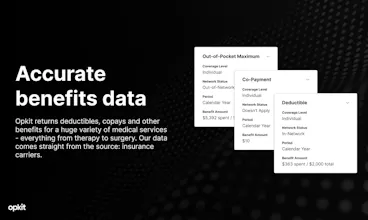
"Verification" = determining if a patient's health insurance plan is active, in- or out-of-network, and whether it includes relevant benefits such as copays, deductibles, etc.
We designed Opkit for telehealth companies and virtual medical clinics, who normally collect and verify patient health insurance details by hand.
Opkit's main feature is the ability to perform “eligibility checks”, or inquiries to insurance carriers about specific patients’ plans. Our software lets you send eligibility checks to hundreds of insurance carriers from across the United States, including most commercial and government carriers.
My co-founder @justin_ko and I are both software engineers, so naturally, our favorite part about Opkit is that it is SUPER developer-friendly. Just about anything you can do through the Opkit web dashboard, you can also do through Opkit's robust, well-documented JSON REST API.
Thank you for your support today! We're excited to hear your feedback and questions. :)
@justin_ko@wdrevno Thanks Will! You're hinting at something big... While Opkit is designed for "providers" today, there's no reason our software can't be leveraged by developers to build amazing new healthcare apps. We are really excited about this possibility!
Report
I still can’t believe how painful it is to share my insurance with a doctors’ office and have no idea how much I’ll actually be charged at the end of a visit. I’m hoping Opkit will fix this — is that the case?
@hcallaway17 Yes! I'm so sorry that this is your experience. Sadly, it feels like something that Americans universally go through when they visit the doctor...
Opkit's software helps telehealth companies (and maybe one day traditional doctor's offices?) to understand what your insurance coverage is _upfront_, so you have better visibility into your coverage and fees. We think our software can make a huge dent in the "price transparency" problem that affects the US healthcare system!
Our ultimate goal is to create "Stripe for healthcare": a Stripe-like checkout flow for transactions involving health insurance. Imagine - a world where using your health insurance is as easy and routine as using your credit card!
Report
@hcallaway17@shcallaway following up on this one, is there a user-facing element? It seemed like Hadley was asking if the user would know the cost, but it seems like only the provider will know, and then its the user's responsibility to ask?
@hcallaway17@nick_depaul There is a user-facing element! It's not featured in our demo video above, but Opkit also has a patient-facing card-upload experience, which we call "Collection Pages". This is a "middleware webpage" (similar to Plaid) that allows the patient to conveniently share photos of their insurance cards with the provider (without having to download a special app). This is first patient touch-point, and we hope to expand it/improve upon it so that patients can have more visibility into their coverage and fees.
Report
Congrats on the launch guys - But since the customer is putting in details so how do you ensure the security and privacy of user data within your product?
@shivi_jalota Great question Shivi! Of course, it's extremely important that we take care of customers' data. Our customers trust us with not only their data, but also their patients' Protected Health Information (PHI), which is protected by HIPAA.
I've already addressed this in my response to @saraiki_vloger (https://www.producthunt.com/post...), but I'll reiterate here:
* Opkit is HIPAA compliant and SOC 2 Type 2 certified
* We are built on AWS, the leading secure cloud, and use AWS security best practices (I myself was a cloud infrastructure engineer in a past life, so I geek out about this!)
* We use Vanta's continuous monitoring solution to make sure our software, systems, etc. are always configured according to our policies
You can see an overview of our security and compliance posture here: https://trust.opkit.co/
Report
@saraiki_vloger@shcallaway oh great ! just read this makes so much sense ! All the best for the launch :)
I'm interested in seeing you guys resolve insurance verification from state-to-state and between specialists. For example, when I lived in NY - I had Oxford which took care of most medical bills, but often services were sent to Optum, who took care of any pharmacy, physical therapy, and chiropractors claims. I'm also interested and would love to learn about your plans for dental and vision care related benefits (as most of those are 'discount plans' than actual insurance). Disclaimer: I worked as an eye doctor in a cash-only practice in NYC
@priya_______ Priya, thank you so much for the insightful comments!
I'm familiar with these "carveouts" where insurance coverage for specific types of care, e.g. psychiatry, is provided by an entity other than the main insurance carrier. These are super frustrating and confusing.
What exactly was the issue with your Oxford/Optum insurance? Were you having trouble figuring out your benefits for these "carveout" services?
Thanks for clarifying!
Report
💎 Pixel perfection
I like it because it makes using your insurance card more like using a pre-paid credit card or discount card. Much less mystery about what is covered. It may open up the possibility of much more granular benefit packages (i.e. many different deductibles or copays for individual providers) so that insurance benefit design can drive patients to lower cost providers.
@hadley_callaway I love this idea. To expand on it a little bit, for the rest of the Product Hunt audience:
Modern American health insurance is weird. It's insurance, in the traditional sense, but it's also "prepaid services". For example, when you buy a health insurance policy, you are essentially buying the right to receive certain medical services for free (or at discounted cost) at some point in the subsequent year.
You don't see "prepaid services" in any other kind of insurance - at least none that I'm aware of.
Think about it. What other kind of insurance do you _plan_ to use? (I hope to never use my renter's or auto insurance, because that means something bad has happened!)
Once you recognize that health insurance mixes these concepts of traditional insurance and prepayment, you can start thinking about your health insurance card as a "prepaid card" that you "swipe" when you go to the doctor's office.
This means Opkit is just like a credit card payment processor!
Report
💎 Pixel perfection
The software provides real-time insurance verification and eligibility. As the health care market reforms and access to health insurance benefit plans is changing rapidly with new legislative changes it is imperative to the success of any health care provider to have software/technology able to ensure payment for services rendered. Opkit provides a platform that brings all payer eligibility verification workflow to one customizable platform. The platform allows healthcare providers to maximize cash flows, minimizes denials from insurance carriers and allows eligible patients to have appointments with providers efficiently. The Opkit software confirms real time coverage by confirming benefits and verifying eligibility in an expeditious manner.
@brian_bizub Brian, thank you so much for your insightful comment. You're right - it is absolutely imperative that healthcare providers adopt modern software tools to stay relevant in this fast-changing environment. We think Opkit can be the go-to payment platform for the next generation of healthcare providers.
Report
Super exciting! The automation Opkit has built looks like it will be amazing for providers (offices and telehealth). Could you share more on how insurance verification is done today?
@gxc2512 Great question Erica!
There are a handful of different ways that healthcare providers verify insurance, including insurance carrier web portals, phone calls, and "electronic eligibility checks" (a feature provided by EMRs and health insurance clearinghouses like Availity).
Unfortunately, these tools/methods are very clunky and require a lot of manual work, which makes the verification process cumbersome. Opkit eliminates most of this manual work by offering a streamlined interface, automation features, and a robust API that developers can leverage to perform insurance verification programmatically.


Opkit
Opkit
Opkit
Opkit
Opkit
Opkit
Opkit
Opkit
Opkit
Opkit
Opkit
Opkit
Opkit