Launching today

Off the Record
Block AI from transcribing your meetings.
41 followers
Block AI from transcribing your meetings.
41 followers
Off the Record reshapes your voice in real time so people can understand you while AI notetakers and hidden interview copilots struggle to transcribe it.

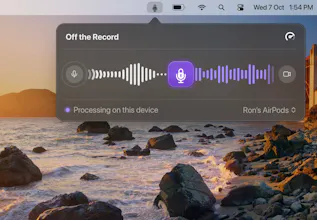

Hey Product Hunt, Ron here 👋
AI is becoming more ambient quietly listening, taking notes, and shaping what we say. Along the way, we're losing control over which conversations we share with it.
I work in cybersecurity, and hiring made this real for me. Some candidates were clearly using AI copilots during remote interviews, and that became apparent when we met in person. That's frustrating for interviewers and unfair to good candidates.
That's why I built Off the Record: a macOS app that reshapes your voice in real time so people can still understand you, while AI transcription picks up almost nothing. It works with Zoom, Meet, Teams, and other apps that use your mic. All voice processing stays on your Mac powered by a tiny AI model.
It started with interviews, but the idea is broader: sometimes you want AI notes, and sometimes you want a conversation to stay a conversation. You should get a say.
I'm also concerned about intelligence agencies using AI to turn phone calls into detailed records, pulling out anything that might be useful and filing it away, all at scale. Making that harder feels worthwhile to me, too.
I'd love to hear how you're handling AI in remote interviews. If you try Off the Record, tell me what works, and especially what doesn't.
Interesting. Definitely a real problem that will become bigger in the future I think. Which transcription models has it been tested against?
Does it only work with the smaller real-time models or does it continue to work with larger offline non-streaming transcription models?
@simon_moxon Thanks Simon! Here's what we test against right now, both the live and the offline kinds:
- OpenAI: gpt-transcribe, gpt-live-transcribe and gpt-4o-transcribe
- AssemblyAI: Universal-3.6 Pro and Universal Streaming (real-time), plus their regular file API
- ElevenLabs: Scribe v2 Realtime
- OpenAI Whisper large-v3-turbo, running fully offline on a GPU
- Apple: the new on-device SpeechTranscriber and Dictation in macOS
And yes, it holds up on the big offline models too, not just the streaming ones. That was actually the harder part. A non-streaming model sees the whole recording at once and has a lot more context to guess from, so we always score against the offline versions too.
In our tests most of the words just don't come through: you get a few stray words, or the model confidently hallucinates something unrelated (Whisper loves "Thank you."). Meanwhile the people on the call can still understand you
It will be a cat-and-mouse game, so we keep retesting as new models come out. If there's a specific one you care about, tell me and I'll run it :)
This could be useful. How is the product priced?
@patrik_pyoria Thanks Patrik! There's a free version that includes an hour of protected calls every week, which is enough for most people to try it in real meetings. Pro is $8/month (or $72/year) and has no limits. For hiring teams there's a per-interviewer plan, $360 per interviewer per year.
Our site now reflects the pricing as well, thank you for the question! :)
the "hidden interview copilots" line in the description is the part that'll follow this product around. blocking an AI notetaker you didn't consent to in a regular meeting is a clean privacy case, but defeating detection of an interview copilot reads as the opposite kind of use, helping someone misrepresent who's actually answering. are those two use cases actually separable in how the product works, or is it the same voice-reshaping trick aimed at whichever listener you want to defeat
@galdayan fair question, and I think it's actually the other way around from how it reads. In the interview case, it's the interviewer who runs Off the Record. The candidate hears the questions perfectly well, but a hidden copilot on their screen can't transcribe them, so it can't feed answers. It's an anti-cheating tool, not a way to hide one.
On whether the two uses are separable: under the hood it's the same thing. It only changes your own outgoing voice, so that people hear you normally and transcription models don't. It can't touch anyone else's audio, and it doesn't hide what's on your screen. So the only thing it lets you decide is who gets to turn your words into text.
Whether that's an unwanted notetaker in a meeting or a copilot listening in on an interview, it's the same principle, your voice, your call :)