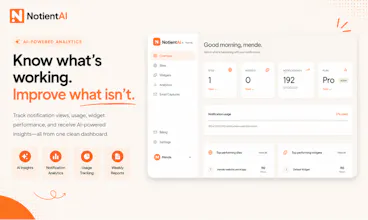
AI social proof popups that adapt to every visitor's location automatically. Mumbai visitor sees "Priya from Delhi just purchased." Austin visitor sees "James from Texas just signed up." Same widget. Zero manual work. AI writes popup copy from your URL Names adapt to visitor location Spin wheel, coupons, quiz widgets Analytics and weekly AI insights Any website. 60 second setup. 7-day free trial from $9/mo.
No reviews yetBe the first to leave a review for NotientAI
Maker
📌
Hey Product Hunt! 👋
I'm Sanju, founder of NotientAI and I'm excited to finally share this with you all.
The idea came from a simple frustration: every social proof popup tool I tried showed the same generic "Peter from New York just bought this" to every single visitor whether they were in Mumbai, London, or São Paulo. It felt fake immediately and I knew it was hurting conversions more than helping.
So I built NotientAI to solve exactly that.
The core insight: social proof only works when it feels relevant to the person seeing it. A visitor from India should see Indian names and cities. A visitor from the UK should see British names and cities. Our AI handles this automatically no manual setup, no lists to maintain.
On top of that we added:
- An AI popup writer that reads your website URL and writes all your copy in seconds (no more blank message box)
- Gamification widgets (spin wheel, mystery coupon, discount quiz) that fire on exit intent these have been the biggest win for email capture
- Weekly AI insights that tell you exactly what's working and what to fix
The hardest part of building this wasn't the product it was payments. Got rejected by Stripe India (invite only) and Paddle (twice). Ended up going with Dodo Payments which is built for Indian
founders selling globally and approved fast. Sharing this because I know other Indian founders face the same wall.
Pricing starts at $9/mo significantly cheaper than alternatives with a 7-day free trial on all plans.
I'd genuinely love your feedback. What features would make this a no brainer for your website?
Try it free at notientai.com
Report
The generic "Peter from New York" problem is one of those things that becomes obvious the second someone names it, and stays invisible until they do. I've watched dozens of DTC brand websites and none of the social proof felt regionally believable, Mumbai visitors were getting Ohio names, London visitors getting Texas cities. Once you notice it, you can't unsee it.
The location-adaptation is the fix, but I'd push further on relevance. Beyond just location, there's a "person like me" signal that goes deeper than country match. A 24-year-old scrolling a hair serum ad feels closer to "Aisha, 26, just purchased" than "James, 52, just purchased", even if both are geographically local. Is there a path to demographic hints from the visitor context (session behavior, referrer, page), or is that a can-of-worms you're intentionally staying out of?
Also respect for naming the Stripe/Paddle rejection in a launch post. That's the kind of honest founder detail that makes a launch feel like a launch rather than a marketing exercise.
You're exactly right that "Peter from New York" problem is one of those things that's easy to ignore until you see it everywhere. Once we noticed it, we couldn't unsee it either, which is what pushed us to build location aware social proof.
The "person like me" idea is something we've talked about internally as well. It's definitely an interesting direction but we also want to be careful not to cross the line into making visitors feel like they're being profiled. Right now we're intentionally keeping personalization lightweight (location, context and page relevance) while respecting privacy.
As for the Stripe/Paddle story, thanks for noticing that too. It wasn't the most fun part of the journey but I figured sharing the real challenges would be more valuable than pretending everything went perfectly.
Really appreciate you taking the time to leave such thoughtful feedback. 🙌
Report
@sanjux97 The privacy line is the right one to hold. "Person like me" done wrong crosses into profiling territory fast, and once users feel that shift the trust goes negative, the exact opposite of what social proof is supposed to do. Lightweight and honest beats invasive and clever every time.
The Stripe/Paddle transparency lands because it's specific. Vague "we had struggles" launch posts are marketing; naming the exact providers and rejections makes it read as real. The Indian founder audience specifically will find that thread useful, it's a common wall and nobody talks about it openly.
I completely agree. Once personalization starts feeling like profiling, it stops building trust and starts doing the opposite. We'd rather keep things simple, relevant and privacy friendly.
And I'm glad the Stripe/Paddle story resonated. I almost didn't include it but I figured sharing the real challenges is more useful than only talking about the wins.
Really appreciate the thoughtful discussion and the support. 🙌
At the moment, the names and locations are AI generated based on the visitor's region to create a localized, privacy friendly experience rather than exposing real customer information.
We intentionally don't display actual customer identities by default, as many businesses prefer not to share personally identifiable information.
That said, we're actively working on more data source integrations so businesses can choose how they want to power their notifications while staying compliant with privacy expectations.
Appreciate the question!
Report
How does the AI actually come up with the names and locations for those popups, are they pulled from real customer data or generated on the fly?
The names and locations are AI-generated based on the visitor's region they're not pulled from your customers or any personal data.
For example, someone visiting from India might see "Priya from Mumbai," while someone in the UK might see "Oliver from London." The goal is to make social proof feel locally relevant without exposing anyone's identity or relying on customer databases.
We built it this way to balance personalization with privacy.
Report
How does the AI actually verify those purchases happened though, or is it just generating plausible-looking notifications?
NotientAI doesn't fabricate purchases or claim real transactions that never happened.
Today, the AI generates privacy friendly, localized notifications based on the configuration you choose, helping businesses create relevant social proof without exposing customer identities.
We're also working on deeper integrations so businesses can use their own data sources where appropriate, giving them more control over how notifications are powered.
Transparency and trust are really important to us, so we want businesses to choose the approach that best fits their needs.
Report
The location swap actually fooled my coworker, he thought real customers were rolling in. Setup took maybe a minute.Tested with a VPN bouncing between regions, the names swapped cities instantly, kind of eerie in a cool way. Setup was genuinely under a minute.The location-based name swaps caught me off guard, my colleague in another country saw a totally different popup with the right city. Painless to set up.
Report
Maker
@hediyema5k Thanks! Just curious did you get a chance to try NotientAI or are you referring to the concept? I'd love to hear more about your experience.
Report
the location-aware copywriting is genuinely clever, feels like it would actually drive conversions rather than just collect dust in a corner of the site.
We noticed that most social proof tools show the same generic message to everyone, regardless of where they're visiting from. We wanted to make notifications feel more relevant without adding any extra work for the website owner.
Really appreciate the kind words and thanks for checking out NotientAI! 🙌






The generic "Peter from New York" problem is one of those things that becomes obvious the second someone names it, and stays invisible until they do. I've watched dozens of DTC brand websites and none of the social proof felt regionally believable, Mumbai visitors were getting Ohio names, London visitors getting Texas cities. Once you notice it, you can't unsee it.
The location-adaptation is the fix, but I'd push further on relevance. Beyond just location, there's a "person like me" signal that goes deeper than country match. A 24-year-old scrolling a hair serum ad feels closer to "Aisha, 26, just purchased" than "James, 52, just purchased", even if both are geographically local. Is there a path to demographic hints from the visitor context (session behavior, referrer, page), or is that a can-of-worms you're intentionally staying out of?
Also respect for naming the Stripe/Paddle rejection in a launch post. That's the kind of honest founder detail that makes a launch feel like a launch rather than a marketing exercise.
@elias_motionfy Really appreciate this comment.
You're exactly right that "Peter from New York" problem is one of those things that's easy to ignore until you see it everywhere. Once we noticed it, we couldn't unsee it either, which is what pushed us to build location aware social proof.
The "person like me" idea is something we've talked about internally as well. It's definitely an interesting direction but we also want to be careful not to cross the line into making visitors feel like they're being profiled. Right now we're intentionally keeping personalization lightweight (location, context and page relevance) while respecting privacy.
As for the Stripe/Paddle story, thanks for noticing that too. It wasn't the most fun part of the journey but I figured sharing the real challenges would be more valuable than pretending everything went perfectly.
Really appreciate you taking the time to leave such thoughtful feedback. 🙌
@sanjux97 The privacy line is the right one to hold. "Person like me" done wrong crosses into profiling territory fast, and once users feel that shift the trust goes negative, the exact opposite of what social proof is supposed to do. Lightweight and honest beats invasive and clever every time.
The Stripe/Paddle transparency lands because it's specific. Vague "we had struggles" launch posts are marketing; naming the exact providers and rejections makes it read as real. The Indian founder audience specifically will find that thread useful, it's a common wall and nobody talks about it openly.
Good luck with the launch. Rooting for it.
@elias_motionfy Thank you that means a lot.
I completely agree. Once personalization starts feeling like profiling, it stops building trust and starts doing the opposite. We'd rather keep things simple, relevant and privacy friendly.
And I'm glad the Stripe/Paddle story resonated. I almost didn't include it but I figured sharing the real challenges is more useful than only talking about the wins.
Really appreciate the thoughtful discussion and the support. 🙌
Hello Inbox
Congrats on the launch @sanjux97
Does it integrate with payment providers to show real user names of the person who just signed up or is it randomly generated?
@ismaelyws Thank you! 🙌
At the moment, the names and locations are AI generated based on the visitor's region to create a localized, privacy friendly experience rather than exposing real customer information.
We intentionally don't display actual customer identities by default, as many businesses prefer not to share personally identifiable information.
That said, we're actively working on more data source integrations so businesses can choose how they want to power their notifications while staying compliant with privacy expectations.
Appreciate the question!
How does the AI actually come up with the names and locations for those popups, are they pulled from real customer data or generated on the fly?
@nazmiyeemi0thh Great question!
The names and locations are AI-generated based on the visitor's region they're not pulled from your customers or any personal data.
For example, someone visiting from India might see "Priya from Mumbai," while someone in the UK might see "Oliver from London." The goal is to make social proof feel locally relevant without exposing anyone's identity or relying on customer databases.
We built it this way to balance personalization with privacy.
How does the AI actually verify those purchases happened though, or is it just generating plausible-looking notifications?
@doukancepijnb0 Great question!
NotientAI doesn't fabricate purchases or claim real transactions that never happened.
Today, the AI generates privacy friendly, localized notifications based on the configuration you choose, helping businesses create relevant social proof without exposing customer identities.
We're also working on deeper integrations so businesses can use their own data sources where appropriate, giving them more control over how notifications are powered.
Transparency and trust are really important to us, so we want businesses to choose the approach that best fits their needs.
The location swap actually fooled my coworker, he thought real customers were rolling in. Setup took maybe a minute.Tested with a VPN bouncing between regions, the names swapped cities instantly, kind of eerie in a cool way. Setup was genuinely under a minute.The location-based name swaps caught me off guard, my colleague in another country saw a totally different popup with the right city. Painless to set up.
@hediyema5k Thanks! Just curious did you get a chance to try NotientAI or are you referring to the concept? I'd love to hear more about your experience.
the location-aware copywriting is genuinely clever, feels like it would actually drive conversions rather than just collect dust in a corner of the site.
@eyllnpd0 Thank you! That was exactly the goal.
We noticed that most social proof tools show the same generic message to everyone, regardless of where they're visiting from. We wanted to make notifications feel more relevant without adding any extra work for the website owner.
Really appreciate the kind words and thanks for checking out NotientAI! 🙌