Launched this week

NoRing
Free Private Call & SMS protection that learns on your phone
9 followers
Free Private Call & SMS protection that learns on your phone
9 followers
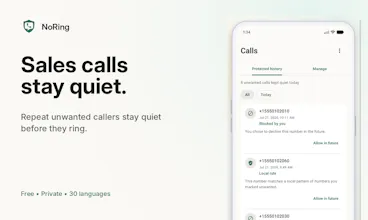
NoRing gives you a quieter phone with adaptive, on-device call and SMS protection. It learns from unknown calls you reject or end quickly, then recognizes repeat and similar number patterns as unwanted callers rotate numbers, helping them stay quiet before they ring. Important and uncertain SMS/MMS stay in Inbox, while likely promotions and suspicious messages move to Quieted. Everything is processed privately on your phone. No account required, free to use, and available in 30 languages.




to do this well on Android you'd basically need to read call logs and SMS content, which is a pretty deep permission ask for an app with no account and no visible company behind it yet. two questions: is this using the official Android CallScreeningService/SMS-app APIs (so it's sandboxed the way the OS intends), or does it need to be set as default phone/SMS app to work? and since everything's on-device with no account, how does detection get better over time, is there any anonymized signal going back to improve the model, or is each phone's "learning" fully isolated to itself?
"Learns on your phone" instead of relying on a central blocklist is an interesting privacy-first approach. How long does it typically take to start reliably distinguishing spam from legitimate unknown numbers once someone starts using it?
@ark_y_k This is the best part, it learns immediately from your past call logs, and messages. It starts from day 1 and keeps improving down the line. Let me know if this clears it up.
@gunveer_sandhu Learning from existing logs solves the cold start, which is usually where these tools feel useless for the first two weeks. That does clear it up.
What I'd want to know next is what happens when my behavior and my history disagree. If I've historically picked up calls from a number but I've since decided I don't want to, does it adjust quickly, or does the accumulated history keep outvoting the recent signal? Recency weighting seems like the whole game here.
@ark_y_k
You’re exactly right about recency.
Explicit feedback always takes priority over historical behaviour. If you mark a number as unwanted, that rule applies from the very next call. “Allow in future” works the same way in reverse.
If you do not correct it manually and simply start rejecting a number that you previously answered, the current automatic learning relies on accumulated call counts and average call duration rather than a decaying recency score. To make that adjustment faster, NoRing shows a notification after you reject a call that was not previously marked as unwanted, allowing you to classify it directly from the notification.
There is a similar prompt when you answer an unknown call but end it within a minute. This covers the common case where you pick up first and only then realise that the call is unwanted. Marking it from the notification gives NoRing an immediate, explicit signal instead of waiting for the accumulated history to change.
So the practical solution today is intentionally simpler than relying entirely on recency weighting. That said, your point still stands: without explicit feedback, recent behaviour can take some time to outweigh older history. Recency weighting is definitely an area I can improve, and I already have a few ideas for it.
Does that answer your question? It was a great catch.
@gunveer_sandhu Explicit feedback overriding history from the very next call is the right priority order. If I've told the system something and it keeps arguing with me based on what I did three months ago, I stop trusting it — and once that's gone the learning doesn't matter much.
That clears it up completely. Thanks for walking through the details rather than leaving it at "it learns" — the mechanics are what actually make it believable.