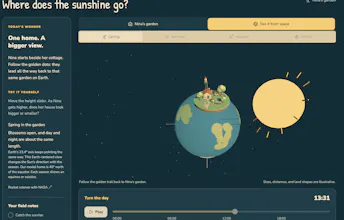
Nina's Little Universe is a handmade, interactive science world I built for my five year old daughter. Children spin Earth to discover day and night, explore Moon phases and eclipses, experiment with light, and meet planets through touch-driven missions. It's bilingual in English and Albanian, free, and requires no account. What began as a personal project for Nina is now being used in schools, helping children learn by touching, testing, and discovering instead of passively watching.
How did Astra change the scope or ambition of what you built?
Maker
I started with “help me explain Moon phases to my daughter.” Astra helped turn that into “what if she could explore them herself?”
The scope grew from a simple explanation into a whole cardboard-style universe with spinning planets, day-and-night missions, Moon phases and eclipses. It made trying ideas fast enough that I could follow my curiosity instead of cutting everything down to the smallest demo.
The biggest shift was going from something I could show Nina to something she could play with—and now something I’m sharing with other families and teachers.
Report
Maker
📌
Hey Product Hunt! I'm Ari, Nina's dad 👋
This started with a simple question: how do I explain Moon phases to my daughter without losing her halfway through?
So I built her a little universe.
Nina's Little Universe lets kids turn Earth, follow their home into daylight, explore the Moon, and play with eclipses. I wanted it to feel like a cardboard world we could have made together at the kitchen table.
I shared an early version on X, and it received over 52,000 impressions and 6,000 link clicks.
It's free to explore. If you are a parent or teacher, try the first day and night mission with a child and tell me:
• Where did they get stuck?
• What could they explain in their own words afterward?
And what space question has a child asked you that sent you straight to Google?
This started as something personal for Nina, but I realized many curious little minds learn better by doing than by listening.