Tinker
Control every aspect of model training and fine-tuning
247 followers
Control every aspect of model training and fine-tuning
247 followers
Tinker is a flexible API for efficiently fine-tuning open source models with LoRA. It's designed for researchers and developers who want flexibility and full control of their data and algorithms without worrying about infrastructure management.
This is the 2nd launch from Tinker. View more

Inkling
Launched this week
Inkling is Thinking Machinesā first open-weights model, a 975B MoE with 41B active parameters, 1M context, native reasoning across text, images, and audio, and controllable thinking effort. Fine-tune it on Tinker or download the Apache 2.0 weights.


Free
Launch Team

Flowtica Scribe
Hi everyone!
Inkling is the first model from Thinking Machines.
It is a 975B MoE with 41B active parameters, a 1M-token context window, and native reasoning across text, images, and audio. The full weights are available under Apache 2.0.
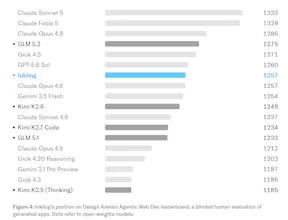
Thinking Machines is clear about what Inkling is for. They say directly that it is not the strongest model available today. It is meant to be a broad base that can be adapted to a specific product or workflow.
You can control how much thinking it uses, fine-tune it on @Tinker, and deploy the resulting checkpoints through several inference providers.
They even had Inkling write and run its own fine-tuning job, turning itself into a model that avoids the letter āeā.
The bet is that a model shaped around your own work can be more useful than a slightly higher score on a temporary leaderboard.
Love that Thinking Machines put the honest framing up front, "this isn't the strongest model today, it's a base you shape around your own work." Most open-weights drops oversell the benchmark line, so leading with adaptability instead is a cleaner pitch, and Apache 2.0 on a 1M-context multimodal MoE is a real gift.
The thing I keep bumping on is that "open weights" and "actually touchable" aren't the same at 975B. Realistically, who fine-tunes a model this size outside of Tinker? Wondering whether the openness is meaningful in practice, or whether downloadable weights are mostly a trust signal and Tinker is the real on-ramp most people will have to take to do anything with it.
Most of our pain when we LoRA an open model comes from the post-training rather than the weights. You tune for a narrow extraction job and the model keeps sliding back into the chatty assistant phrasing it picked up in RLHF, and you burn epochs beating that out. Is there a raw pre-trained checkpoint alongside the released one, or is the Apache 2.0 drop the post-trained model only? For something billed as a base to build on, that distinction decides a lot.
the framing of being explicitly not the strongest model but the best base to adapt is refreshing, most labs oversell the raw benchmark score. with 41B active params out of 975B total, what's the realistic hardware floor for someone fine-tuning this through Tinker, is this something a well-funded startup can do on rented compute or does it really need lab-scale infrastructure?
Would love to see built-in support for evaluating checkpoints mid-training, so we can compare LoRA adapters on a validation set without writing custom eval loops. A simple callback or webhook when a checkpoint saves would go a long way for experiment tracking.
Built a quick LoRA job on Tinker yesterday and the setup was honestly painless. One thing that would be a huge help though: a built-in diff viewer or summary that shows what changed in the merged adapter weights so I can sanity-check before pushing to prod without having to script it myself.
one thing that would make tinker a lot more useful for me is built in support for evaluating models right after fine tuning, like running a small benchmark suite automatically so you can see if your lora actually helped without wiring up a separate eval pipeline