Humalike
Give your AI agents the social intelligence they're missing
1.2K followers
Give your AI agents the social intelligence they're missing
1.2K followers
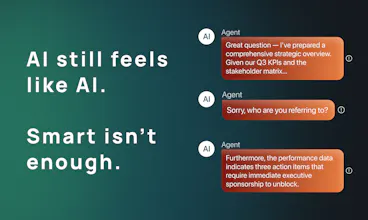
Today's models are capable enough. Smart enough. Fast enough. But we still feel they don’t fit in the room. Humalike is building the behavioral infrastructure for humanlike AI agents. The social skills & proactiveness your agents have been missing. APIs, models, benchmarks.
This is the 2nd launch from Humalike. View more
Humalike x Hermes
Launching today
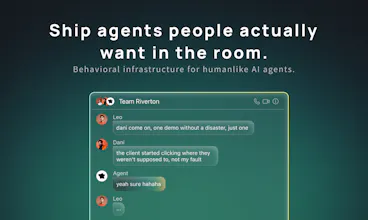
One command gives your Hermes agent social intelligence. It decides when to speak, adapts to your group's tone and remembers who said what. Works in group chats on Slack, Telegram and WhatsApp.


Free Options
Launch Team / Built With


Humalike
Hey PH 👋 Martí here, co-founder of Humalike.
What is Humalike? The behavioral infrastructure for humanlike AI agents. The social skills your agents have been missing.
Today we're shipping the fastest way to feel what that means: a plugin that makes your Hermes agent fit in 1-1's / groups.
The problem
We run Hermes agents in our own Slack and Telegram. Brilliant at tasks. Painful to use in groups and treat is as a companion. It answered every single message, talked over people, spammed 10 lines when one was enough. Everyone knew it was a bot instantly. That's not a model problem, it's a behavior problem.
- What the plugin does: Decides, when to jump in and when to stay quiet
- Paces replies like a human: typing speed, pauses, 1-3 short messages instead of a wall
- Learns how your group talks and matches the tone
- Remembers who people are and what matters to them
One command to install. Works in group chats on Slack, Telegram & WhatsApp.
Where it shines
👨💻 Coworker: steps up when it can actually help
🍻 Group chats: no longer the awkward one in the room
👨👩👦 Family chat: reacts to the puppy photo like everyone else
🤝 Friend: knows you well enough to say no
What we'd love from you
Install it and tell us the when you had the "aha" moment (if it didn't, that's the feedback that matters most).
We'll be here all day reading everything!
Backed by the first investors in ElevenLabs, Revolut & more.
Still the same tiny 🇪🇸×🇵🇱 team, & still not sleeping much :))
Visla
@mcarmonas congrats Martí - wish you and the team all the success in the world.
Humalike
@mogabr 🫶🫶🫶
@mcarmonas Congrats on the launch. In groups where people have mixed expectations, how does Humalike decide which social role to adopt, and can users teach or correct that behavior over time?
Humalike
@swati_paliwal 100%! Agent starts with a personality X, and adapts over time (thanks to Norms / Social Memory). It's not perfect yet, and it would be a lie to say that using it for 3 months will make it 10x better. If you know somehow for 3 months, a human (friend) actually is 10x better, so there's still a long way to go!
Congrats on the launch @marticarmona! Decoupling the behavioral layer from the LLM core is definitely the right architectural move for conversational agents.
Because the plugin remembers 'who people are and what matters to them' in shared group settings (Slack, Telegram, WhatsApp), how does Humalike manage multi-user memory boundaries? If User A shares context in a 1-on-1 thread with the agent, how does the underlying knowledge graph prevent that memory from surfacing in a shared team or family group chat where User B is present?
jared.so
@franz_brionesFor now, the underlying memory doesn't prevent it. We want the behavioral layer to be able to correctly assess what information should be shared and what shouldn't :)) It's, of course, a very hard problem and we don't claim to have an absolute solution.
Humalike
@franz_briones Tysm for the support Franz!
The "decides when to speak" gating is the actually hard part here — an agent that stays quiet 90% of the time is worth more than one that answers every message, but that means the plugin holds group context the base Hermes agent doesn t. Where does the "who said what" memory live: inside my own Hermes runtime, or a hosted Humalike service the group messages get routed through? And is the speak/stay-silent decision a model call on every message (latency + cost per turn) or a lightweight local classifier?
@noctis06 Hey Noctis, these parts live on Humalike side. Both memory and classifier are on our side for few reasons:
1. ease of integration
2. easy way to ship improvements
3. the Hermes plugin uses Humalike APIs that are transferable from product to product. That means if you ever wanted to create your own agent you can easily use Humalike APIs and get similar behavior as Hermes x Humalike
Cost per turn is low from what we tested, when you sign up you get 10.000 free credits which should be enough for months of normal usage for hermes agent.
Let me know if you are concerned about something else specifically:))
What I'd want to know is how long the decision takes. In a live group the window where a message is still useful is a couple of seconds wide, and every should-I-speak check we tried added another model call, so by the time it came back yes the thread had moved on two messages and the reply read as odd. Is the gating a small fast classifier sitting in front of the main model, or does the same model produce both the decision and the message?
@dipankar_sarkar Hey, I think these are two separate things:
1. actual latency for making a decision
2. "group has moved on" problem
We solve 2 really well by handling interruptions and making sure agent doesn't respond to old messages. About 1, yes, it adds latency, and it's not perfect. In our testing it's not a deal breaker in chat, LLMs are fast enough (compared to humans that acutally have to type each message). I encourage you to give it a try and see how you like it, we would love your feedback!
Congrats on the launch! The behavior layer being separate from the model is interesting. Everyone tunes what the agent says, few teams touch when it should shut up. Are you guys biasing it toward silence by default? Socially that feels right, but the failure mode I'd worry about is probably the false negative, the message it should've jumped on and skipped instead
@artstavenka1 Thanks for the question! 🫶
jared.so
@artstavenka1Hey Art! These are some sharp insights you've got here. I'd say it's way harder to make agents biased toward silence, false positives are much harder to get rid of than false negatives, and they make the agent super annoying.
I'm here if you have anymore questions :))
The turn-taking API is the part that got me. Knowing when to stay silent is honestly the harder problem than knowing what to say. Curious how you handle group dynamics where multiple people are typing at once, does the model factor in who's been most active? Congrats on the launch, excited to see where this goes!
jared.so
@vanmurten_eth Alexey! You're right, this problem is super hard. We handle it like a real human would, which means that as a new message comes in, the agent looks at the whole conversation and decides whether it should reply to any message from the conversation, taking the new message into account as context.
I am happy to answer any other questions you might have :))
Humalike
@vanmurten_eth Thanks for the supp Alexey!
@vanmurten_eth Agree!
I appreciate that this tackles a problem many developers notice after deployment. Technical accuracy alone rarely creates comfortable interactions. Will there be tools for testing personality consistency before releasing agents?
@john_michael31 Hey, yes! We have an audit page where you can paste transcript of any agent (powered by Humalike or not) and you will have detailed analysis of how it performs.
We also have CLI for it if you want to run this analysis on recurring basis e.g. once per week!
Humalike
@john_michael31 :))) https://humalike.ai/audit