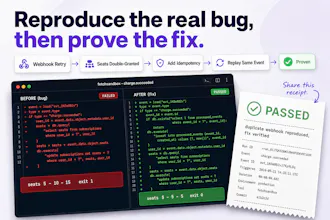
The agentic integration engine addresses a critical void in traditional API mocking by simulating deep state lifecycle events, network failures, and complex async workflows instead of basic static responses. Operating via a native Model Context Protocol (MCP) server layer, FetchSandbox injects directly into AI development systems like Cursor, Claude Code, and Windsurf to replicate real-world environment anomalies like out-of-order webhook delivery, token timeouts, and late event retries. By maintaining a persistent, runnable record of caught bugs and integration breaks inside the development framework, it empowers both developers and coding agents to programmatically verify and fix failure boundaries over 60+ pre-seeded cloud APIs without draining real-world testing quotas.
FetchSandbox
Raj here, one of the co-founders.
Writing the integration stopped being the hard part. Checking that it actually works is the whole job now, and that's the half your agent can't do.
The gap
Your agent can write a Stripe integration. It can't run one. It writes the code, tells you it's done, and you find out in production whether that was true. FetchSandbox gives the agent already in your editor two things it doesn't have: somewhere real to run integration code, and a way to prove the fix worked.
Why the proof check matters
A customer paid for 5 seats. A retry gave them 10, then 15. An agent fixed it, and after the fix nobody got any seats at all. Tests still passed because the duplicates were gone. Almost any fix makes the error disappear. Far fewer make the data right.
So the gate asserts the exact end state a correct implementation leaves, and refuses to go green when it can't reproduce the bug first.
Setup
One block in your MCP config. No API key, no signup. Works in Claude Code, Cursor, Cline, Windsurf, and Codex. 70+ ready-made sandboxes: Stripe, HubSpot, Clerk, Resend, Twilio and more, free to try.
We hit #3 on our first launch. The ask afterward was exactly this: don't just give me a sandbox, tell me my fix actually worked. This is that.
Has your agent ever confidently fixed something that was still broken?
FetchSandbox
Install, takes about thirty seconds.
Add this to your MCP config. That's `.mcp.json` in your project root for Claude Code, or Settings → MCP for Cursor:
```json
{
"mcpServers": {
"fetchsandbox": {
"command": "npx",
"args": ["-y", "fetchsandbox-mcp@latest"]
}
}
}
```
No API key, no signup. Claude Desktop needs a full quit and reopen, Cmd+Q, not just closing the window.
Try it without touching your own code first
Type this to your agent, not your terminal — the ./fetchsandbox prefix is just how you tell it to use the MCP:
"./fetchsandbox Test my Stripe webhook for duplicate deliveries"
Takes about a minute and you'll get a receipt URL.
Or the one I'd show a skeptic:
"./fetchsandbox Paddle events arrived out of order and reactivated a paused subscription"
Then point it at something real
Name the API and what you're seeing:
"./fetchsandbox Stripe webhook signature verification fails for valid events"
@rnagulapalle giving the coding agent an actual sandbox environment to fail against before calling a PR ready is a massive unlock. Congrats on the launch🙌
FetchSandbox
@priya_kushwaha1 yeah "fail against before calling a PR ready" is exactly the frame, the agent needs a place to be wrong safely before it's confident. appreciate you getting it so quickly!
FetchSandbox
@charan_t_m thanks, really appreciate that! the proof-check piece is the one that surprised me most too, turns out "it's fixed" and "here's a receipt showing the failure flipped" land very differently when you're reviewing an agent's PR.
PicWish
@rnagulapalle are you using deterministic sequence pinning for the out of order webhook replays yet? saw in the thread it was next up, getting that right without flake is really hard.
FetchSandbox
@mohsinproduct not yet, still pinning the sequencing logic down. you're right that flake is the real enemy there, replaying out-of-order is easy, replaying it deterministically so your test doesn't pass Tuesday and fail Thursday is the whole problem. working through the state machine ordering before I ship it so it's actually trustworthy. what's your current setup for testing that edge, curious if you've hit a specific pattern that's hard to reproduce.
RunEvr
@rnagulapalle This is a really smart approach to API testing! Good luck guys.
Testing webhook idempotency with AI agents is an absolute nightmare they always silently fail or fake the fix. Forcing the agent to prove it worked with an actual receipt URL before merging is brilliant. qq Are you planning to let us add custom internal enterprise APIs to the sandbox list soon? Upvoted...
FetchSandbox
@vikramp7470 Thanks so much, the silent fake fix is exactly what kept me up at night building this. Custom internal APIs work today actually, drop any OpenAPI 3.x spec at `/import-spec` and it spins up a fully stateful, schema-validated sandbox in about 5 seconds, so you're not limited to the built-in specs. Would love to hear what internal APIs you're working with if you give it a shot.
AutoChat®
The end-state assertion is the strongest part here. In SaaS billing and automation work, preventing a duplicate event is only half the problem—the final subscription, entitlement, and audit state all need to agree. Does the sandbox also let teams test reordered events and delayed retries across the same workflow?
FetchSandbox
@modiyilreji yes, exactly the problem i was trying to solve. delayed retries are covered via scenario switching mid-workflow, you can flip the sandbox into a degraded or rate-limited state between steps and re-trigger. reordered events are supported too; workflows in the spec configs let you sequence the same events in different orders so you can assert on the final state, not just whether each event "succeeded." the end-state check is what actually matters in billing flows.
"almost any fix makes the error disappear, far fewer make the data right" is the whole thing, and it is the same shape as the problem we keep running into.
to answer your question: yes, and the worst one was not even an agent. we added an anthropic key and three things were wrong at once. opus rejects an explicit temperature outright, one haiku model id had been retired and returned 404, and our own code sent a temperature on every call. nothing failed in testing because nothing in testing actually called it. any customer who had selected opus would have had every single reply fail on the first try. we were offering an integration nobody had ever executed.
the related one scares me more. we ran eight models against a live pricing api and two of them read the wrong row of a price ladder that was sitting in their context. one quoted 39.00 for an order that costs 9.60, the other quoted 9.00. the 39.00 gets caught by anyone glancing at it. the 9.00 does not, and that is the one that reaches a customer.
so the thing i would want to know about the proof step: does it assert the response shape, or the actual values? a 200 with a plausible wrong body is the failure that survives every check we have tried.
FetchSandbox
@jernej_jan_kocica three failures at once and none of them visible until the key hit prod, that's exactly the shape that's hard to catch in any test that doesn't actually run the provider's validation. the retired model id returning 404 especially, that's the kind of thing you only find when something real is on the other end. glad this resonated, and that war story is going straight into how i explain the "why" of this thing.
what kind of integrations do you have?
FetchSandbox
@adamkamaneh 70+ you can run right now, Stripe, Paddle, HubSpot, Clerk, Resend, Twilio, GitHub, Notion, Shopify, Discord, Datadog, RevenueCat. Payments, auth, email, messaging, CRM are the clusters with the most depth.
All of them run, real state, webhooks, lifecycle. About 15 also have the failure library on top, the curated set of known ways that specific API actually breaks in prod. Duplicate delivery, retries on stale state, signature verification failing on valid events. Those are the ones where it reproduces a named bug instead of just exercising the happy path. Stripe is deepest.
HubSpot is the one I've pushed hardest on the CRM side.
If yours isn't listed, point it at any OpenAPI spec and it stands up a sandbox from that. You just don't get the failure library for it, you'd be exercising the API, not the known failure modes.
Where this is going since you asked about kinds: single third-party APIs are the starting point. The version I actually care about is standing up a whole internal service graph, several services and the third parties they depend on, all at once. Built a version of that this week for a company that rebuilds systems it acquires. Three services in one scenario, caught the new implementation skipping a call the old one made while everything else looked fine. That's the thing.
Which one were you thinking of? Genuinely useful to know what people reach for first.
FetchSandbox
@adamkamaneh 67 today — Stripe, GitHub, Twilio, OpenAI, Clerk, WorkOS, Resend and more. Anything not in the catalog, import an OpenAPI spec and you get a stateful sandbox with the same webhooks and failure injection.
What are you integrating with?
FetchSandbox
@tehreem_fatima5 pact is great for locking down the contract between a known consumer and provider in CI. fetchsandbox is less about "did the schema match" and more about running the full lifecycle: stateful CRUD, webhook delivery, auth failures, rate limits, all from inside the agent's IDE session. for an LLM agent the rapid iteration piece matters a lot, it can reproduce a specific failure, fix the code, and get a proof receipt back rather than just validating shape.
Netlify
Testing and verifying AI integration fixes in a sandbox before deploying saves so much headache. Congrats on shipping!
FetchSandbox
@thisiskp_ thanks man!!..Yeah exactly, same bug, very different discovery method. Finding it before deploy means you fix it in your editor. Finding it after means a customer tells you about it at some inconvenient hour. That's the whole thing we're trying to shift.
FetchSandbox
@thisiskp_ Thanks! Honestly that pain is exactly why we built this. Catching a bad config or an edge case token error in sandbox vs in prod is a completely different experience.. one costs you sleep, the other costs you 10 minutes.