
Most shopping tools chase coupons. Dupely tackles trust. Online shopping is full of manipulation: artificial price drops, fake reviews, paid influencers, and sketchy white label sellers reselling the same product at a markup. DupeScore finds identical products for less. Trust This Price flags fake savings using 90 days of price history. Seller badges show you who's actually credible. Now on iOS, Android, and Chrome. Dupely is the trust layer online shopping has been missing.


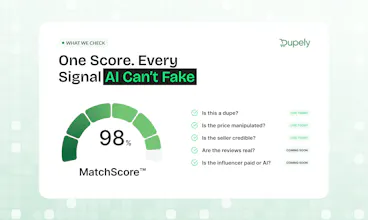


Hello world! We built Dupely because we kept getting frustrated with duplicate listings on Amazon. There are a million tools out there for resellers to get on the first page but none to help consumers cut through the dupes.
Today, we ship a fully functioning app + extension to help consumers get the best deal from reputable vendors on iOS, Android and Google Play!
As your using Dupely, feel free to tag me with some of your top dupes, feature ideas and if there's anything we can do to make the user experience that much better.
Thank you very much for your support and we look forward to building this into the trust layer for eCommerce!
@jacob_galajda Congratulations! wide reach "Now on iOS, Android, and Chrome"
@jacob_galajda @kutlwano_melamu Thanks! We're also on Brave with Safari/extension and Edge support coming soon!
@kutlwano_melamu Thanks Kutlwano, we wanted everyone to have access to Dupely!! :D
@jacob_galajda That's a real milestone
The part nobody's asked about is the matching itself. Deciding two listings are the 'same product' is the whole game, and Amazon makes it ugly: a serum sold as 30ml vs 1oz, single unit vs a 2-pack, a renamed variation ASIN, a bundle with a free sample tacked on. When I worked on product matching, title plus image similarity got us to maybe 80%, and the last 20% (unit counts, pack sizes, refurb vs new) was where every wrong dupe call came from. A wrong dupe stings more than a missed one, since you're steering someone to buy the cheaper thing that isn't actually the same. How are you drawing that line today?
@dipankar_sarkar Good call out - I'll give a simple example of what we are actively avoiding against. You want to buy a multivitamin and we recommend the 90 back vs the 270 count.. of course the 90 count will be significantly cheaper so we want to surface the Price Per Unit Savings and not recommend not similar quantities.
This is very tricky because sellers could upload as unit quantity, or pack or variations (child ASINs) etc. so there is a lot to go into making sure we're truly comparing apples and apples not apples and broccoli. Bad analogy probably but I think the point stands.
Great callout. Actively on @jacob_galajda and teams radar
Yeah, the unit normalization is exactly where it gets ugly. In extraction work the title and the structured pack field disagree constantly, '90ct' in the name but a 3x30 variant underneath, and whichever one you trust is wrong a surprising share of the time. What worked for us was treating price-per-unit as low-confidence unless two signals agreed (title regex plus the variant field), and just hiding the per-unit number when they didn't rather than showing a wrong one. A wrong savings figure kills trust faster than a missing one.
@dipankar_sarkar 100% Dipankar, low confidence signal and multiple checks to toss that result if it's not in alignment. There are no standardizations for unit pricing options on any platform we've explored😅 thanks for using Dupely! :D
Congrats!! Can users customize what matters most, like price history, seller trust, or return rates?
@himani_sah1 Yes absolutely you can sort by what matters most to you today. The filters we have so far are: DupeScore/MatchScore (so how close the item is to the original) Price, Reviews, Ratings, Price Per Unit. Ultimately these filters will be saved to your profile so it auto-sorts by what matters to you. For example you might want to sort by Price or Ratings vs how close to the original product the results are.
@himani_sah1 Not in todays version this is on the roadmap but we do have filters live today.
What's live today on how users can sort by what matters to them: DupeScore, Most Savings, Reviews, Ratings, Price Per Unit
Downloaded the iOS app and was surprised how often "fake savings" tags popped up on stuff I'd been eyeing. DupeScore saved me like $12 on a serum that's literally identical to the pricier one.
@naimefidan5e7b That's awesome Naime! Glad we could save you $12, thanks for using Dupely! :D
@naimefidan5e7b You're going to find that this happens more often then you think. We're saving users on average $16 on their carts. Return rates are 5x lower than industry standard
how does the trust this price feature actually pull that 90 day history for smaller or niche brands that dont have a ton of listings tracked yet
@umuto39k Great question Umut! Currently, the data we get from our vendor maintains a decently comprehensive history on all products. There are some gaps in coverage today, but we'd like to develop our data program further to address the smaller/more niche brands that are just getting started. Thanks for using Dupely! :D
How do you actually get the 90 days of price history for every product, do you scrape retailers directly or pull from some third party API?
@baharws54 Great question Bahar, we use APIs from multiple data vendors to get the data quickly. From experimentation, scraping in real-time at volume has a lot of latency issues that make it difficult to support a free user model. Thanks for using Dupely! :D