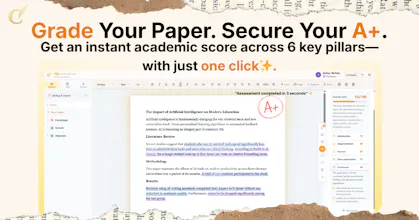
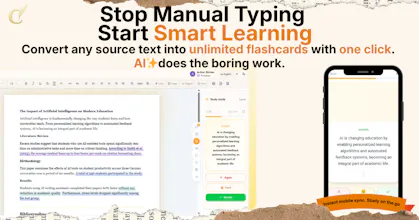
I started with 1 question: how can students use AI without getting in trouble? The more I built, the more ideas came. Flashcard generator at 2am in bed. Citation formatting — I'll spare you where that idea hit me 😄 The point is: students don't lose time writing. They lose it on everything around it. Citations, grammar, structure. Hours of work that has nothing to do with actually thinking. Clio handles all of that. Not to write for you — to give you your time back. The ideas don´t stop.
No reviews yetBe the first to leave a review for Clio AI
Maker
📌
Hey everyone, founder here 👋
I built Clio because I watched students spend more time on citations and formatting than on actually thinking and writing. That felt wrong.
Clio handles everything around the paper — citations in 15 styles, AI table of contents with real page numbers, grammar suggestions, and flashcards you can study on your phone. You focus on the ideas, Clio handles the rest.
One thing I'm proud of: Clio doesn't write for you. As universities get better at detecting AI content, Clio will be the tool students can still trust — because your voice stays yours.
Would love honest feedback from this community. What would make you actually use something like this? What's missing?
Try it free at app.getclio.ai — brutal honesty welcome. 🙏
Report
@arti90 does it really make it sound like me? Am I describing some custom settings for myself, or actually configuring them?
Report
Maker
@julia_zakharova2 Great question Julia! Clio analyzes your existing text and gives you feedback based on your own writing style — it doesn't try to replace it. Think of it less like a settings panel and more like a mirror that shows you where your academic voice is already strong and where it could be clearer.
What would matter more to you — a tool that adapts to your style automatically, or one where you can fine-tune it yourself?
Report
@arti90 Settings are probably a thing of the past, but they're still present in many AI tools. Adaptation is also important to me, as it speeds up decision-making.
Report
Maker
@julia_zakharova2 I think you’re right to value adaptation and speed, but in the context of a writing tool for students, it’s a very fine line.
Too much automation quickly turns the tool from an assistant into something that replaces the student’s actual work. That’s where ethical issues start, especially in academic environments where the work is supposed to reflect the student’s own thinking.
My approach is to keep the student in control of the writing process. The AI should support thinking, not replace it. For example, helping with structure, pointing out weak arguments, or giving feedback on clarity — but not generating full sections or “doing the work” for them.
So instead of full automation, I focus more on intelligent assistance and real-time feedback. That way, the tool still speeds things up and improves quality, but the core work and ideas remain the student’s.
Report
@arti90 That’s a thoughtful approach. I agree the balance between assistance and replacement is important, especially in education. Good luck with Clio!
Report
Congratulations on the launch! This is actually really interesting to me as an ex-educator. Can I ask, does Clio pull everything from the student’s own work, as to avoid any accidental plagiarism by generating new material? If so, I love that this is genuinely AI supporting a student’s work, not doing the real work for them! A fab idea!
Report
Maker
@leah_dyke Thank you Leah, that means a lot coming from an educator!
Yes — exactly that. Clio works with the student's own text. The grammar suggestions, the academic scoring, the flashcards — everything is based on what the student has already written. Clio doesn't generate new content and insert it into their work.
The student writes. Clio supports. The voice and the ideas stay completely theirs.
And we actually have a built-in plagiarism checker as well — so students can verify their own work before they submit. One more reason to feel confident handing it in.
Report
@arti90 I love, love, love this. Not many AI tools are being developed with student-centric approach or with an awareness of ethical AI use in education. Great product!
Report
Maker
@leah_dyke I can't even put into words how much this means to me right now, thank you so so much!
Report
This would have saved me so much time in college. I remember sometimes worrying more about how the citations looked than the actual content of my papers. The will allow students the ability to focus solely on the content of their research. Great job!
Report
Maker
@bill_mccormick09 That's exactly it — citations stressed me out more than the actual content too, and that just felt wrong. The paper should be about the ideas, not the formatting.
Report
Good luck with the launch!
Report
Maker
@alexchristou17 Thank you Alex! Means a lot on launch day. Have you ever had to deal with the citation and formatting struggle as a student? 😄
@arti90 does it really make it sound like me? Am I describing some custom settings for myself, or actually configuring them?
@arti90 Settings are probably a thing of the past, but they're still present in many AI tools. Adaptation is also important to me, as it speeds up decision-making.
@julia_zakharova2 I think you’re right to value adaptation and speed, but in the context of a writing tool for students, it’s a very fine line.
Too much automation quickly turns the tool from an assistant into something that replaces the student’s actual work. That’s where ethical issues start, especially in academic environments where the work is supposed to reflect the student’s own thinking.
My approach is to keep the student in control of the writing process. The AI should support thinking, not replace it. For example, helping with structure, pointing out weak arguments, or giving feedback on clarity — but not generating full sections or “doing the work” for them.
So instead of full automation, I focus more on intelligent assistance and real-time feedback. That way, the tool still speeds things up and improves quality, but the core work and ideas remain the student’s.
@arti90 That’s a thoughtful approach. I agree the balance between assistance and replacement is important, especially in education. Good luck with Clio!
This would have saved me so much time in college. I remember sometimes worrying more about how the citations looked than the actual content of my papers. The will allow students the ability to focus solely on the content of their research. Great job!
Good luck with the launch!
@alexchristou17 Thank you Alex! Means a lot on launch day. Have you ever had to deal with the citation and formatting struggle as a student? 😄