
ACME.BOT
No-slop AI SEO agent that interviews you first
273 followers
No-slop AI SEO agent that interviews you first
273 followers
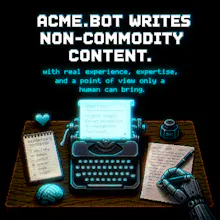
ACME.BOT turns your expertise into no slop SEO articles. Answer a few questions on a topic (from your phone) and your first-hand experience shapes your blog post. AI handles the boring stuff. Like keyword research, illustrations, references, internal linking, and publishing cadence. Create helpful non-commodity content that also satisfies Google's EEAT requirements.



Free Options
Launch Team / Built With


Dropbox SignSimple, secure eSignatures for the way your team works.
Promoted
Thank you @rohanrecommends for hunting us here today!
I left my job as a search infrastructure engineer at Google to start building AI products as an indie maker almost a decade ago, with my first launch being on this very platform.
A big pain point I faced while running my SaaS was the ability to reliably run a business blog. My options were
Hire content automation team / Hire freelancers - extremely expensive money-wise and time-wise. Not for most small-medium sized companies.
Duct tape an AI automation - time consuming and fragile / hard to get right and be consistent
“Slop Cannon” blog automation tools - dishonest to your audience / prone to search engine penalties
There had to be a way to reliably create content that takes the best of me (my opinions / counter-intutive thesis / expertise) and turn into posts that is genuinely useful to my audience - but it seemed like it just did not exist.
So, we built ACME.BOT - first for us. To be able to run our own blog with our own AI SEO agent.
Some key features:
💬 Chat driven — accessible via web chat / Telegram even on your phone!
🎙️ Interview mode — conducts an interview on the topic to understand your perspective and build the basis for the post
🔍 Deep Research — finds supporting facts and research backing your point of view
🗓️ Keyword research & content calendar
📊 Diagrams — visually represent concepts
🎨 Brand Tone — learns your voice from reference material
✍️ Humanizer — reduces the chance of being flagged as AI writing
🚧 Approval Gates — makes sure human checks are in place when needed
🚀 Auto-publish to Shopify and WordPress
🧠 Knowledge Base — everything you do on the platform feeds an ever-improving repository of your business context
At the heart of ACME.BOT is Human-In-The-Loop mechanic that drives the whole blog writing process collaboratively with low friction. So you step in only where you are genuniely irreplacable. Let ACME.BOT handle the rest.
Our initial set of users loved our features (like interviews, diagrams, deep research, run from phone).
Excited to be launching it here today!
As a part of our PH launch week we're offering free trials (no CC required) to everyone from PH. Sign up for the free trial here.
@abhishek_iyer The interview-first step is the interesting bet. Most AI SEO tools I've tried fail because they never learn what the business actually sells, so they optimize for traffic nobody converts. What does the interview capture that a good brief wouldn't, and how do you keep it from drifting back to generic keyword output after a few runs?
@artem_fedorovich Glad you see it - our goal was to be able to write genuinely useful articles for the audience. If they wanted a pure AI take, they could just ask an AI itself.
Re. inteview v/s a good brief: in our experience the interview is a very low effort task and serves to prompt an expert into answering. Think of the feeling you have during a conversation with someone in a field you're truly passionate about. Compared to that writing a good brief feels cumbersome and is comparatively very high-friction.
Re: the output drifting back to slop: it actually has the opposite effect. All the interviews are stored in a knowledge base. So it ends up compounding over time.
Dyuti, you asked why people quietly stop publishing AI drafts, so here is mine: every draft read as competent and generic at once. No number I had earned, no opinion I would defend in a room, so putting my name on it felt like a small lie, and fixing that by hand cost more than writing from scratch.
The interview flow is the right fix, because the missing input was never the words, it was the first-hand material only I had.
One question, from running SEO in a narrow B2B healthcare niche: the posts that convert for me have almost no search volume and rank on depth, not keywords. Does the research chase volume, or can it work the low and zero-volume long-tail questions real buyers actually type?
@clemente_lopez1
On volume: So search volume is a lagging, averaged signal. In a narrow B2B niche the queries that convert often show as zero in every tool because the tools round down anything under ~10/month. So no, the research doesn't rank topics by volume alone. The interview + your knowledge base surface the questions your actual buyers ask (which you know and no keyword tool does), and the keyword research is there to shape the piece around how those questions get phrased
Honestly, healthcare B2B specifically is a good stress test for us - esp. if you try it on one of those zero-volume posts, Would love to hear whether the interview pulled out the depth that would make the post useful and make it rank!
PS: "Competent and generic at once" is going on a wall somewhere
the feature list has a "Humanizer - reduces the chance of being flagged as AI writing" line right next to the EEAT/no-slop pitch, and those two things sit a bit awkwardly together. if the content is genuinely built from a real interview with someone's first-hand expertise, why does the output still need to be disguised from AI detectors? that reads like the underlying draft is more AI-generated-then-dressed-up than the interview-first framing suggests. is the humanizer mostly smoothing awkward phrasing, or actually working to defeat detection tools specifically?
@galdayan The motivation is to not disguise - it's actually to just iron out the awkward phrasing etc. The fact that it ends up beating AI detection is a side effect, not the explicit goal.
You've covered depth-vs-volume well in here, so a different axis: does the interview pull provable specifics — a number, a named tool, a dated before/after someone could actually check — or mostly first-person phrasing? I keep a hand-written voice corpus to stop my app's LLM writing from sliding into the beige AI register, and the thing that reads as "real" instead of "sounds real" is almost always a verifiable detail, not tone. EEAT is drifting toward corroboration over voice too, so "sounds like someone did this" and "demonstrably did this" are separating. If the interview captures the checkable stuff, that's the moat; if it's voice, slop catches up a model generation later. (You'd know the search side of that better than most.)
Hi@narek_keshishyan - exactly. We care about that distinction a lot.
When it interviews you on a topic it pushes for specifics.The goal of the interview is to pull out the specifics from you that you never had the time to write down.
Voice is actually handled seperately through reference sources you provide.
I always wanted more control over what I post. This looks interesting.
In the process of trying it out for my blog.
Ps - how can I make it work for my custom built blog?
@mitalee_rao Hi Mitalee - What custom stack are you on? If your custom blog is on Github / with markdown, we have a GitHub connector. You can try it from the connectors page.
the interview-first angle makes sense as a way to avoid the generic AI-blog-post feel. how long is a typical interview session though - is this a quick 5 question voice thing on your phone, or does getting genuinely useful first-hand detail out of someone take more like a 20 minute back and forth?
@omri_ben_shoham1 The default is set to a short one, but it offers to go on if youre up for it - so it really does not have an upper limit on how long / deep the interview goes.
What genuinely surprised me is that how even a small 3 question back and forth can shape how an article turns out.
Another thing I'd like to point out is since all interviews go into the Knowledge Base there is continuity in the interviews - so over time the small interviews also add up to get really meaty.
ACME.BOT
The “interviews you first” approach is interesting. SEO agents often jump straight into execution, but the quality of the initial diagnosis probably determines whether the recommendations are actually useful. Curious to see how you handle cases where the founder’s stated SEO problem isn’t the real bottleneck.
@aryan787544 Great question, and worth clarifying a little about the purpose of the interview. It's less about being an SEO diagnosis of your content, and more of a way to pull out your first-hand material, the opinion and numbers that make a post worth reading.
Research handles the diagnostic part separately. Keyword research and content calendars are based on search data from the audience, not from what you assume they search.
So if your stated problem is not the real bottleneck, the data usually surfaces that on its own.
@abhishek_iyer That's a thoughtful separation between extracting original thinking and diagnosing the SEO opportunity.
What I'm curious about is what happens when those two disagree. For example, if the founder's strongest first-hand insight has very little search demand, do you optimize for discoverability or for publishing something genuinely differentiated? That feels like one of the more interesting long-term tradeoffs for products like this.
@aryan787544 So there are two things here: the topic to write about and the take on the topic.
Re. Topic: By default data powers the topics to write about. However this can be always overriden.
Re. the Take: This is where it gets interesting. Having a differentiated take that defies traditional wistom / data is actually golden. Especially when writing about a topic that is data backed / mainstream. This is the type of content that is missing in the Slop AI posts and the type of content that readers will actually find useful.
@abhishek_iyer @abhishek_iyer I really like that distinction. I think that's where your approach becomes more than another SEO tool—they help founders publish ideas that are genuinely worth reading, not just easier to find.
I've got a couple of thoughts on this positioning that I'd love to share if it's useful. Happy to continue the conversation however you prefer.