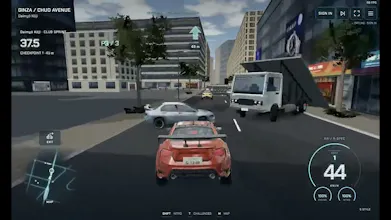
Explore a compact Tokyo Bay, meet NPC rivals, chase local records and race friends. Cars, bikes, jumps, drifts and changing weather—all in your browser. Play solo without signing in; join online rooms with ChatGPT.
GPT-6 Astra was used to turn real Tokyo geospatial data and OpenStreetMap road networks into a browser-native 3D city for Tokyo Afterhours. It helped translate complex urban data into drivable roads, expressways, bridges, waterfronts, landmarks, and recognizable districts including Ginza, Shiba, Odaiba, and Toyosu.
The engineering challenge goes far beyond visualization. The city streams dynamically around the player while supporting 120 Hz vehicle physics, traffic, pedestrians, weather, races, and real-time multiplayer across desktop and mobile.
Tokyo Afterhours is also deployed through OpenAI Sites, with Sites providing hosting and authenticated player identity that connects directly into the multiplayer infrastructure.
The result is a full-stack 3D multiplayer experience that turns real city data into a living, playable Tokyo inside the browser.
I wanted a Tokyo driving game that you can open in a browser and immediately get lost in for a few minutes.
Tokyo Afterhours adapts Ginza, Tsukiji, Shiba, Shibaura and the bay into a compact arcade playground. The latest addition is city life: nearby invitations, NPC club sprints, parking meets, local jobs and discovery rewards. You can play solo without an account, or sign in to race in online rooms.
I built and iterated on it with Codex, with hands-on direction and repeated driving tests. Much of the work has been the unglamorous part: connecting roads, fixing collisions, streaming scenery and keeping mobile browsers usable. Models, map data and artwork have their own credits; this is not a claim that every asset was made from scratch.
It is still a browser beta. I would love to hear where you enjoyed driving, where the city feels empty, and what phone/browser you tested on. What should the next neighbourhood event be?




LingoTime
LingoTime