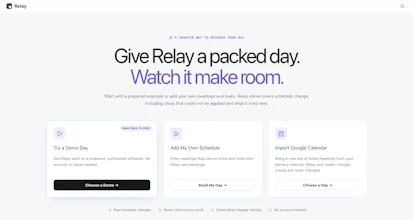
Relay is a visual autonomous scheduling agent that repairs overloaded workdays. Watch it inspect conflicts, choose deterministic tools, recover from rejected actions, and validate the final schedule—without directly rewriting your calendar.
How did GPT-5.6 change the ambition or scope of what you shipped?
Maker
Relay started as a hackathon idea to fix overloaded schedules. Working with GPT-5.6 encouraged me to think beyond an AI assistant and build a true autonomous agent.
It helped me iterate on the architecture, tool-based execution model, validation pipeline, and user experience so the product shows every decision the agent makes instead of hiding everything behind a single response.
The final product is much more ambitious than my original concept because it focuses on transparency, deterministic execution, and recovery from failure rather than simple text generation.
Report
Maker
📌
Hey Product Hunt! 👋
I’m Suyash, the solo maker behind Relay.
I built Relay during an AI hackathon because I wanted to understand what separates a real autonomous agent from another LLM-powered wrapper.
Most scheduling assistants take a request such as “fix my day” and return a newly generated schedule. The interesting work happens invisibly, and users have no idea whether the model followed real constraints or simply produced something that looked reasonable.
Relay takes a different approach.
The model cannot edit the schedule directly. It can only select one deterministic tool at a time, for example, inspecting the day, finding an available slot, moving a task, splitting work, inserting a break, or deferring something.
Each tool can succeed or fail. When an action is rejected, Relay leaves the schedule untouched, records the observation, and asks the agent to change its strategy. A separate deterministic validator, not the model, decides whether the final workday is valid.
I also made the entire process visible, including:
• Schedule inspection
• Tool calls and structured outputs
• Rejected actions
• Strategy changes and retries
• Before-and-after results
• Final deterministic validation
• Step-by-step replay without another AI call
You can try a prepared overloaded day without creating an account, build your own schedule, or import one day from Google Calendar in read-only mode.
Relay started as a hackathon project, but it became an exploration of a larger question:
How should we design AI products when the model is responsible for decisions, but deterministic software remains responsible for execution and correctness?
I’d love your honest feedback—especially on the visible agent experience, the scheduling decisions, and whether this makes autonomous-agent architecture easier to understand.
Thanks for checking out Relay! 💜