
NeuroVidz
See how a brain reacts to your clip
94 followers
See how a brain reacts to your clip
94 followers
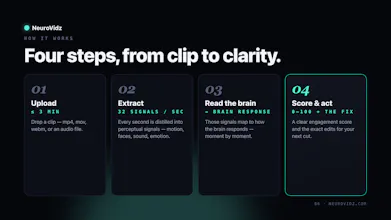
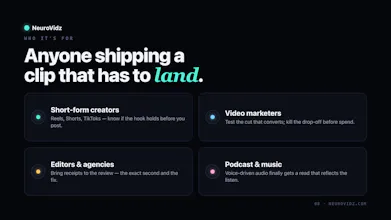
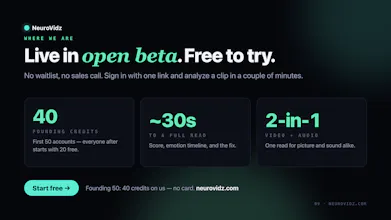
Upload a video or audio clip. In about a minute, NeuroVidz maps how a brain would respond to its picture AND its sound — an engagement score that shows its components, a per-second emotion timeline, and timestamped suggestions for your next edit. Most tools focus on the frames alone; NeuroVidz listens too, so podcasts, music, and voice-driven clips score like a listener feels. If it can't produce a confident read, it refunds the credits. Start free, no card — founding 50 accounts get 40 credits.



Free
Launch Team / Built With


ArticosYour audience, ready to react to your messaging in minutes. Try free
Promoted
saw your reply to Aidan below - appreciate the direct answer that it's a forward model against published neuroimaging weights, not fitted to real retention data. genuine follow-up: if it isn't validated against actual audience retention, what's the evidence that the engagement score correlates with what real viewers do, versus just being internally consistent with itself? asking because "stimulus-driven, not viewer-specific" is honest but it also means the score could be confidently wrong in a way no refund policy would catch.
@galdayan Fairest challenge on the page, so a straight answer in three parts.
What we have: the weights come from published studies in which researchers measured real people responding to real stimuli — their evidence, not ours, but it means the construct isn't self-referential. What we don't have: an end-to-end study correlating our composite against real retention curves. You're right about that gap — and right that abstaining can't catch it. Abstain guards against unreadable input; it says nothing about whether the construct is aimed true.
What we do about it: treat the score as a falsifiable claim, not a verdict. The product's honest use is within-clip and relative — "this passage gives attention a reason to slip" — which any creator can check against their own retention graph in minutes. We invite exactly that comparison and keep a falsification log; documented misses change the weights or narrow the claims. If you have clips with known retention, run them. That's the validation study — one clip at a time.
Thanks!
@ud22 appreciate the straight answer, especially naming the gap instead of talking around it. the falsification log is the right instinct - that's basically what would make me trust a number like this over time. I'll hold off forming a real opinion until there's a batch of clips run against actual retention data, but "here's how to prove us wrong" is a much better answer than most of these tools give.
@galdayan Thank you — holding off until there's real data to judge by is completely fair. If you ever run it against clips whose retention you already know, we'd love to hear how it lands, either way.
@ud22 will do - bookmarking this thread so I remember to circle back if I ever run a batch through it. good luck with the falsification log, that's a rare thing to commit to publicly.
This is a fascinating angle for video creators — most analytics tools tell you what happened (views, drop-off points) but not why. Curious what's actually being measured here: is this modeling predicted neural response from visual/audio features, or do you have real EEG/biometric data feeding the model? That distinction matters a lot for how much I'd trust the output as a creator deciding what to cut.
@abhineetarora Thanks — you've drawn the right distinction, so straight answer: it's the first one. Modeled response from what's actually in the clip — no EEG or biometric data, and nothing recorded from viewers.
Concretely: we measure 25+ properties of the picture and sound every second — motion, cuts, luminance and colour dynamics, visual complexity, faces and their expressions, sound energy, onsets, speech vs silence — and map them onto the seven canonical cortical networks using weights grounded in published neuroimaging (attention systems, task-positive vs default-mode dynamics, face/voice selectivity). The score and timeline are derived from that predicted response.
For your trust question as a creator: where it earns its keep is within-clip, relative judgment — "attention likely slips here, holds there" — which is exactly the what-to-cut decision. It doesn't know your audience and won't predict your retention curve. And when a clip doesn't give the measurements enough to work with, it says "no clear read" instead of scoring anyway.
@ud22 Appreciate the depth here, especially the honesty about what it doesn't do — a tool that admits "no clear read" instead of always forcing a confident-sounding number is rare, and it's exactly what makes the confident scores more trustworthy when they do show up. The within-clip relative framing makes a lot more sense than I initially assumed — that's a genuinely useful signal for editing decisions without overclaiming what it can predict about real audience behavior. Nice work.
@abhineetarora Thanks!
The thing I'd want to understand is what the prediction is validated against. "How a brain would respond" can mean a model fit to EEG data, or one fit to actual retention curves from real viewers, and those two behave very differently once a clip looks unlike whatever it was trained on.
Very cool - congrats on the launch.
@aidan_codefox Thanks so much — Fair question — and the honest answer is "neither."
It's a forward model, not a fitted one: we measure ~30 properties of the picture and sound each second (motion, cuts, colour and luminance dynamics, faces and expressions, sound energy, onsets, speech vs silence) and map those onto the seven cortical networks using weights from published neuroimaging. So what's validated is the mapping layer — each weight traces to a published result — not a regression against brain recordings or watch-time.
Your distribution point is the sharp one: a forward model doesn't silently extrapolate past a training set, it degrades when the measurements stop meaning anything — no faces, very dark footage, no usable audio. That's detectable, so when a read doesn't clear its reliability bar we return "no clear read" rather than a confident number.
It's stimulus-driven, not viewer-specific, and it doesn't predict retention. Worth testing our attention dips against clips whose drop-offs you already know.
uploaded a 30 second podcast clip and the per-second emotion timeline actually picked up on the pause before the punchline, which i didn't expect from a tool like this. the refund promise is a nice touch too.
@ayaz540061 The pause is the fun one to have caught — a beat of silence before a payoff is a genuine attention trigger (an unexpected absence of sound registers as salience, same as a sudden noise), so the engine treats silence as signal rather than dead air, and the listen pass marks the beat as its own moment instead of smoothing it over. Glad it showed up on a 30-second clip. Curious how it does on your longer episodes.
Thanks
Honestly the audio part is what sold me, most engagement tools totally ignore that. One thing though, would be cool if you could compare two versions side by side before exporting, like drop in a re-cut and see how the emotion timeline and score shift. That would make the refund policy almost irrelevant because people would just keep tweaking until the numbers move in the right direction.
@englsarpolpe3b The audio part being what sold you is exactly the bet we made, so thank you. And yes — side-by-side is the feature we want too: drop in a re-cut, see the timeline and score shift against the original. It's high on the post-launch list, and half the plumbing already exists (re-running an unchanged file is free, so the baseline never costs you anything — you'd only ever pay for the new cut).
One small reframe on the refund: it isn't "money back if the score disappoints" — it's for when we can't read a clip cleanly. We'd rather say "no clear read" and refund than hand you a confident number we don't believe. So keep-tweaking-until-it-moves is genuinely the workflow we're building for; the refund just guarantees every number you're tweaking against is one we'd defend.
Honestly the audio piece is what sold me here, finally something that gets that podcasts and music-driven clips need attention too. One thing I'd love: a way to compare two versions of the same clip side by side so I can see which edit is actually pulling more engagement second by second. Would make the refund policy almost unnecessary.
@nurullahekizler Thanks — the audio bet keeps being the reason people show up. Side-by-side compare is high on the post-launch list (Şengül suggested the same below): drop in a re-cut, watch the timeline and score shift against the original. Half the plumbing exists already — re-running an unchanged file is free, so the baseline side would cost nothing.