
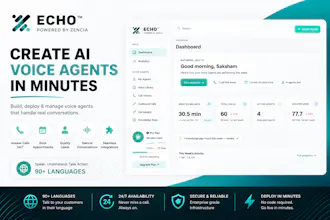
ECHO by Zencia is a SaaS platform for creating, deploying, and managing production-ready AI voice agents in minutes. Build AI receptionists, sales agents, customer support assistants, recruiters, or custom voice employees with persistent memory, custom knowledge bases, and knowledge-gap detection. Connect your business tools, automate calls, qualify leads, book appointments, and deliver multilingual voice AI in 90+ languages—all without building complex voice infrastructure
👋 Hi Product Hunt!
We're excited to introduce ECHO by Zencia AI, a SaaS platform for building production-ready AI voice agents in minutes.
While building voice AI, we realized most teams spend more time integrating telephony, speech-to-text, LLMs, text-to-speech, memory, workflows, and business tools than actually building the agent itself. We built ECHO to simplify that entire process.
With ECHO, you can create AI receptionists, sales agents, customer support assistants, recruiters, or custom AI voice employees from a single platform.
✨ What makes ECHO different?
• 🧠 Persistent memory across conversations
• 📚 Custom knowledge bases with knowledge-gap detection
• 🎙️ Natural, real-time voice conversations in 90+ languages
• 🔗 CRM, calendar, and business integrations
• 📞 Inbound & outbound calling with intelligent workflows
• ⚡ Deploy production-ready AI voice agents in minutes
We're just getting started and would love your honest feedback. If you could automate one phone-based workflow with AI, what would you build?
How does the knowledge-gap detection actually flag something, like does it surface unanswered questions in a dashboard so I can feed the right answers back in?
@berfintxoj Great question! Yes 😊
Whenever Echo isn't confident about an answer, it flags it as a knowledge gap. You can find those directly in the Call History along with the full transcript. From there, it's literally a one-click action to add the missing information to the knowledge base, so the agent gets better over time.
Feel free to explore it and let me know what you think or if anything feels unclear—we'd love your feedback!
Love how the knowledge-gap detection is framed as a first-class feature instead of a hidden settings toggle. That tells me the team actually thought through what makes a voice agent useful in production, not just a demo.
@smet1588346 Thank you! 🙌 That was exactly our goal. Real conversations always reveal knowledge gaps, so we wanted to make them easy to spot and fix instead of hiding them. Really appreciate you noticing that!
Hooked up the knowledge base to my own docs and it actually picked up on niche terminology without me retraining anything, which surprised me. Also the multilingual switch feels pretty natural, not robotic.
@zilan123060 Thanks! 🙌 That's exactly the experience we were hoping to create. Really appreciate you trying Echo and sharing your feedback.
Plugged in my help docs and had a voice agent answering callers in under ten minutes. The knowledge-gap alerts caught two questions I would have missed, which is honestly what sold me.
@azad1216215 Thank you! 🙌 That means a lot. Really appreciate you giving Echo a try and sharing your experience!
how does the knowledge-gap detection actually work in practice, does it flag unanswered questions in real time or surface them after the fact?