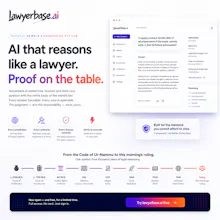
lawyerbase is built to be the world's definitive legal intelligence platform. The whole of the world's law; Turkey, US, EU, UK, Germany, France, Japan, and more. Answered with numbered citations, every answer independently audited against its sources, uncertainty named, unsourced knowledge kept apart. Contract Studio maps any contract clause by clause and reviews it against the governing law itself. Upload documents, ask follow-ups, keep every thread. It sharpens your judgment; it never decides.
No reviews yetBe the first to leave a review for lawyerbase.ai
Hunter
π
Hello Product Hunt,
Today we're opening lawyerbase to everyone here. Not a waitlist, not a demo β the full platform, free until August 1.
Our ambition is stated on the front page: to build the world's #1 legal intelligence platform. And we believe the platform already stands where nothing else does β no other product combines the whole of the world's law across twelve jurisdictions and every tradition, an independent audit that checks every answer statement by statement against its own cited sources, and a Contract Studio that reviews contracts against the governing law itself rather than a checklist. Verifiable grounding at this scope is the frontier, and it is exactly the ground we've chosen to hold.
We built it because of a problem this community knows well. AI answers legal questions with total confidence, then invents the citation. Lawyers have been sanctioned in real courtrooms for trusting exactly that. And for everyone who isn't a lawyer, it's worse β you have no way of knowing you've been misled. The technology that was supposed to open up legal knowledge produced the one thing nobody can use: answers that can't be checked.
So we built the opposite, and we'd rather show you than tell you.
Every answer in lawyerbase arrives with the authorities behind each line β statute, code, treaty, ruling β one click from the passage itself, not a paraphrase of it. Before any answer reaches you, an independent audit checks it statement by statement against those very sources. What can't be supported is repaired or flagged, never smoothed over. Where the law is genuinely unsettled, the answer says so plainly. And what comes from general legal knowledge, rather than the sources on the table, sits in its own clearly marked section β so you always know which is which.
The corpus spans the United States, the European Union, the United Kingdom, Germany, France, TΓΌrkiye, Japan, India, Canada, Australia, Spain, and Ireland β every tradition, growing daily. The reasoning adapts to the field your question belongs to: maritime, tax, competition, employment, IP, family, and beyond.
There is a second half to the platform. Upload a contract and Contract Studio maps it clause by clause β indemnity, limitation of liability, termination, assignment β then tests each clause against the governing law's own provisions, with the statute cited next to the risk it raises. You can question the document directly: what early termination actually costs, who carries the risk, where the caps bite. PDFs up to 50MB go straight into the conversation.
One principle holds everything together: lawyerbase strengthens human judgment β it never replaces it. The decision, and the responsibility, stay with you. We consider that a feature, not a limitation.
Here is what we'd ask of you today.
If you practice law: take the hardest question on your desk and put it to the platform β then click the citations. Don't take our word for anything. Verifying us takes seconds; that's the point.
If you run a company: upload the contract you signed without reading every clause. Ask what it actually says. You'll know within minutes.
If you study law: an exam-preparation companion is next on our roadmap β practice and essay feedback grounded in real statutes rather than flashcards. Tell us in the comments what your preparation is missing, and you will shape what we build.
If you simply have a legal question you've been carrying around β a deposit, a notice period, a warranty dispute β ask it. See the actual law behind the answer, possibly for the first time.
And if your instinct is to break things: please try. Ask the trap questions. If you catch a claim our audit missed, post it here. We'll fix it in the open and say so.
We're early, and we won't pretend otherwise β some corners are still rough, and the corpus grows every single day. We've chosen to build in public, answer by verifiable answer. What you tell us today decides what gets built next.
Everything is included until August 1 β every feature, no card, no tiers. Sign in at lawyerbase.ai and bring your hardest question.
If what we're building resonates with you, your support here today carries further than you might think β it decides who discovers this, and what we build next. We'll be here all day, answering everything.
Report
How does the audit process actually flag uncertainty, like does it show confidence scores or just call out gaps in the citations? Also wondering if Contract Studio works on scanned PDFs or only text-based uploads.
On uncertainty: no confidence scores, deliberately. After the answer is written, an independent audit pass checks every statement against the exact passage it cites and returns a categorical verdict per sentence: fully supported, partially supported (the claim sharpens or generalizes beyond what the source states), unsupported, or missing a citation it should have. Anything not fully supported is shown to you with the specific sentence and a one-line reason β e.g. "the provision number isn't in the cited text." We chose verdicts over scores because a 0.87 tells a lawyer nothing actionable; which sentence to double-check and why does. Flagged answers also go through a repair pass and are re-checked before you see them. The audit is a strong signal, not a substitute for reading the sources β which is exactly why every citation opens the passage itself.
On scanned PDFs: Contract Studio currently needs a text layer (PDF, Word, or plain text) β clause-by-clause segmentation and per-clause review depend on it. A scanned/image-only contract gets a clear message rather than a silently degraded review; that trade-off is deliberate. In the research chat, scanned documents and photos can be read directly, so you're not blocked entirely β but the full clause-by-clause treatment needs text today.
How does the audit process actually flag uncertainty, like does it show confidence scores or just call out gaps in the citations? Also wondering if Contract Studio works on scanned PDFs or only text-based uploads.
@linaeresinΒ
Great questions β happy to be specific.
On uncertainty: no confidence scores, deliberately. After the answer is written, an independent audit pass checks every statement against the exact passage it cites and returns a categorical verdict per sentence: fully supported, partially supported (the claim sharpens or generalizes beyond what the source states), unsupported, or missing a citation it should have. Anything not fully supported is shown to you with the specific sentence and a one-line reason β e.g. "the provision number isn't in the cited text." We chose verdicts over scores because a 0.87 tells a lawyer nothing actionable; which sentence to double-check and why does. Flagged answers also go through a repair pass and are re-checked before you see them. The audit is a strong signal, not a substitute for reading the sources β which is exactly why every citation opens the passage itself.
On scanned PDFs: Contract Studio currently needs a text layer (PDF, Word, or plain text) β clause-by-clause segmentation and per-clause review depend on it. A scanned/image-only contract gets a clear message rather than a silently degraded review; that trade-off is deliberate. In the research chat, scanned documents and photos can be read directly, so you're not blocked entirely β but the full clause-by-clause treatment needs text today.