
Forward
Installs your API into a customer's codebase in one command
143 followers
Installs your API into a customer's codebase in one command
143 followers
Forward is an AI forward-deployed engineer that integrates your API directly into your customers' codebases. Instead of 50-page docs, users run one command. Forward analyzes their repo, writes the integration on a new branch, runs tests, and opens a PR for review. Built for API and SDK companies to eliminate churn between signup and the first successful call. It learns your house style and ensures safety through build validation—all while saving users hours of manual wiring.


Forward installs your API into a customer's codebase with one command. The customer runs `yourco-install` in their repo, our agent reads the code, writes the integration on a branch, runs their tests, and opens a pull request. They review and merge. Signup to shipped, in minutes.
We built it for API and SDK companies where users have to write code to get value. Payments, auth, observability, messaging, voice, video. The integration step is where activation goes to die for these products.
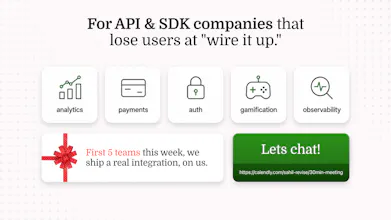
For the PH launch: first 5 teams that book a call this week, we ship your first integration agent end-to-end, free. Real proof on a real codebase.
https://calendly.com/sahil-revise/30min-meeting
Or just hit me up on linkedin: https://www.linkedin.com/in/sahil-kathpal/
If you've watched users get stuck wiring up your API, I would love to hear what you tried.
Best,
Sahil
what happens when Forward gets the integration wrong and the PR has bugs. the customer ran one command, a PR appeared, they merged it, and now something is broken in their codebase. the trust model for AI-generated code that touches production integrations requires a clear answer to the failure case. what does the support and correction flow look like when the generated integration doesn't work as expected
@ansari_adin Agree 100% with the concern. The crux here is keeping it isolated. And yet give the integrating team a clear understanding of your features and the integration touchpoints. Seeing it on my own code will beat looking at snippets in the docs anyday.
That said, we're using a mature agent harness (Pi) and realistically all base cases and issues will be covered and tested by Forward itself.
More opinionated teams could ofcourse want to tweak the integration before merging into anything remotely live.
This seems useful for API products where the first integration is the hardest part. Opening a PR directly is a strong idea. How do you make sure the generated integration fits the customer's existing code style and stays safe to merge?
@busra_seker1 Thanks! And yes, as a dev myself, I agree the PR feels pretty forward (pun not intended :) ) The thinking here is to give the team a clear understanding of your features and the integration touchpoints. Seeing it on my own code will beat looking at snippets in the docs anyday. Most importantly, this stays in its own branch. The team merges only after it fits their style and expectations.
More opinionated teams will always want to tweak the integration before merging into anything remotely live.
Shifting API integration from the customer's engineering team back to the vendor is the right direction. We've seen integrations stall for weeks because of environment config differences and dependency conflicts on the customer side. Having an install that runs in one command flips who bears that burden. How does Forward handle cases where the target codebase has conflicting package versions or an unusual build system?
How does this one differ from just using Claude Code (or any coding agent) and prompting "integrate <API docs>"
The integration layer seems to be becoming a bigger bottleneck than the models themselves.
Once companies have dozens of internal tools and APIs, are you finding that the challenge is exposing capabilities to agents, or maintaining reliability and governance once those agents start taking actions?