
Chat Skills for AI Agents
One file. Any agent. Working chat in under 10 minutes.
208 followers
One file. Any agent. Working chat in under 10 minutes.
208 followers
Add fully functional chat to your React app using AI agent skills. Drop in a skill file and your agent handles the full integration: installation, environment setup, SSR-safe rendering, and the correct init and login flow. One file per framework. Works seamlessly with Cursor, Kiro, VS Code Copilot, Claude, and Codex. Go from zero to a working chat in minutes, built on CometChat's proven foundation and ready for real projects from day one.
This is the 2nd launch from Chat Skills for AI Agents. View more
Calling Skills for AI Agents
Launching today
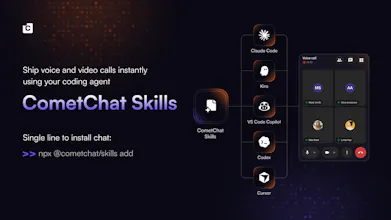
HD voice and video calling by CometChat, built to fit into and grow with your platform. Packed with recording, screen sharing, call logs, raise hand, broadcast mode, picture-in-picture, and more. Integrate via UI Kits, SDKs, or a single npx command (npx @cometchat/skills add) using CometChat Skills. Scales with heavy bandwidth, compliant with global standards, and built for developers.


Launch Team

Chat Skills for AI Agents
Hey Product Hunt! Swapnil here, AVP engineering at CometChat.
A few months ago we launched Chat Skills, a skill file that lets your AI coding agent integrate CometChat's full chat product in under 15 minutes. The response was incredible. Today we're back with the next one: Calling Skills.
v4.2.0 of the CometChat Skills package adds first-class voice and video calling integration across 6 platform families: React, Next.js, React Native, Angular, Android, iOS, and Flutter.
Here's what makes it different from just pointing your agent at the docs:
The dispatcher asks one question before it touches your project: Ringing or Session? These are fundamentally different integration paths. Ringing means a full incoming/outgoing call surface, CallKit on iOS, ConnectionService on Android, VoIP push to wake the device. Session means a link-driven meeting room where both peers join the same session ID, no ringing surface, no Chat SDK dependency. Getting this wrong mid-integration is expensive. The skill resolves it up front.
Once you pick a mode, the agent detects your framework and SDK version, scaffolds the correct file structure, and runs a 23-point verification pass covering VoIP push configuration, SDK initialization order, hangup teardown, permission strings, and API drift issues we caught and fixed across Android, iOS, Flutter, and React Native.
If you're already using Chat Skills, this is fully additive. Same install, same mental model, no changes to your existing chat integration.
Drop your questions below, I'm here all day.
@swapnull Hey Swapnil, congrats on launch number two. The "Ringing or Session, resolve it up front" detail is the part that shows this was built by someone who's actually been burned mid-integration, getting that wrong late is exactly the expensive kind of wrong. The thread you opened that I'd pull harder on is the 23-point pass catching API drift across four platforms. That's the real maintenance nightmare in SDK-first integration: the skill scaffolds correct code against today's SDK versions, but six platform SDKs drift independently and constantly. Three months out, CometChat ships a breaking change or iOS deprecates a permission API, and the integration the agent wrote is now quietly wrong. So is the skill the thing that re-detects and re-scaffolds when an SDK moves, or is it a point-in-time generator and drift becomes the developer's problem again? Because "working chat in 10 minutes" is the easy promise, "still-working chat in 10 months without a rewrite" is the one that decides whether teams trust generated integrations. Following along.
The SDK-first design here is smart. Wrapping WebRTC into agent-callable tools means the agent owns the session lifecycle rather than punting that complexity to the app layer. At RetainSure we've been building AI workflows for customer success and native call-handling always meant a separate service layer. How are you handling SIP/PSTN bridging for enterprise customers who need traditional telephony alongside IP calling?
Interesting timing for this launch given how quickly AI agents are moving from chat to real-time interaction.
Curious where you see the biggest adoption curve happening first:
AI sales/support agents handling live customer conversations?
Internal enterprise copilots?
Consumer-facing assistants?
Also wondering how you’re thinking about trust signals in voice/video interactions with AI agents. Do you think the winning platforms will need visible “human handoff” layers and transparency features built directly into the calling experience?
Adding calling via a single npx command is a real DX win. Most teams spend days on integration boilerplate that should be a one-liner. We've been building in the customer success for developer tool companies space, and Calling Skills for AI Agents touches on something we think about a lot. How does the skill handle conflicts with existing auth in apps that already have a communication layer?
We built something like this from scratch once. The main issue was video latency when participants were far away from each other. You need servers in different parts of the world and a lot of other things. Did you manage to solve this problem somehow?
mailX by mailwarm
Does it support real time transcripts and tool events so the agent can act during the call?
Stripo.email
Congrats on the launch! The “drop in a skill file and it just works” approach is honestly the missing piece for a lot of AI-assisted development workflows. Very smart idea to handle SSR safety, auth flow, and setup automatically instead of making developers fight docs for two hours first.