PartFinder gives manufacturers part-level supply chain risk intelligence. Upload a BOM or parts list, score every component's risk, see geographic exposure, shortage signals, lead-time volatility, find alternates, compare specs, and send request for quotes - all from one platform. Most teams discover supply issues when shipments fail. PartFinder helps them act earlier.
No reviews yetBe the first to leave a review for PartFinder
Maker
📌
Hey Product Hunt! 👋
I'm Jeffrey, co-founder of PartFinder.
We built PartFinder because manufacturers still manage critical sourcing decisions across spreadsheets, supplier portals, PDFs, emails, and outdated systems. That works fine until one part breaks the whole plan.
A small sensor, PCB, or motor controller gets delayed. Lead time jumps from 8 weeks to 22 weeks. A supplier is concentrated in one risky region. A tariff hits. A shortage starts. But by the time the team realizes what happened, production is already exposed.
We both saw that problem, from different angles.
I came from a risk management background at Morgan Stanley, where risk is modeled, monitored, and acted on before losses happen. But in manufacturing, teams often don't have the same part-level risk visibility.
My co-founder @OlivierBuilds saw the pain directly while building hardware. Validating one alternate part took weeks and created real cost, delay, and sourcing risk. Olivier is an AI systems architect leading PartFinder’s technical build, with semiconductor engineering experience from Cirrus Logic.
So we asked: why can't manufacturers upload a BOM or part list and instantly know which parts are risky, why they are risky, and what to do next?
That became PartFinder.
PartFinder gives manufacturers part-level supply chain risk intelligence. Upload a BOM or parts list and PartFinder:
- Scores every component's risk and maps geographic exposure
- Flags shortage signals and lead-time volatility
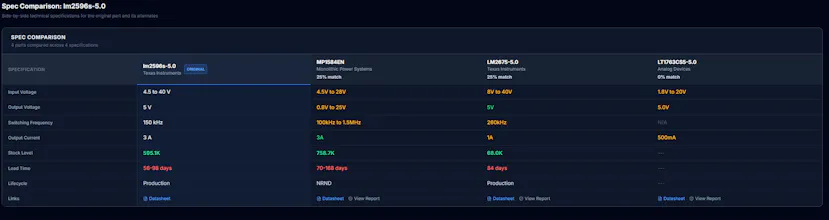
- Finds alternates and compares specs side by side
- Lets teams send RFQs directly from the platform
What changed while building this:
At first, we thought this was mainly a part search problem. But after 100+ conversations with manufacturers, procurement teams, engineers, and operators, it became clear the bigger pain was not just "where can I find this part?" It was:
- Which parts are exposed?
- Why are they risky?
- What alternates are actually usable?
- Who should we contact?
- How fast can we act before production gets stuck?
So PartFinder evolved from a sourcing tool into a risk-to-action platform.
Our goal is simple: help manufacturers find supply issues before shipments fail, costs rise, or production stops.
We’re excited to share PartFinder with the Product Hunt community today.
We’d love feedback from anyone working in hardware, manufacturing, procurement, engineering, supply chain, or industrial AI:
- What would make this most useful for your team?
-What risk signals should we prioritize next?
- How do you currently track part-level supply risk?
We’ll be here all day reading comments and answering questions.
Find us at partfinder.dev or follow @partfinderdev on X.
— Jeffrey & Olivier
Report
Interesting idea, curious how you’re defining “risk” for each part. Beyond stock and lead times, what else are you looking at to decide when a part might become a problem?
Report
Maker
@yesenia4 Yeah - we have an algorithm that looks at several components together, not just stock or lead time.
It considers things like:
Geography exposure: Is the part tied to one risky region?
Lead-time volatility: Are lead times starting to jump?
Replacement difficulty: Are there many alternative options that match the part?
Disruption exposure: Could events like China tariffs, port strikes, Red Sea delays, or Strait of Hormuz tensions affect it?
So even if a part looks available today, the algorithm can flag it if multiple signals suggest it may become a problem soon.
Wow, this is super impressive. I'm curious where you're getting the disruption feed from and how that's calculated into the risk of every individual part.
Report
Maker
@jacob_barnes Thanks Jacob, We scan multiple public and industry sources for OSINT-style and other disruption events, then map those events to the parts/categories/regions they may affect.
Congrats on the launch, Jeffrey. Out of all the products I’ve been browsing on Product Hunt lately, this is probably the most unique one I’ve seen. I keep up with the news a lot, so the idea of connecting world events to part-level supply risk is genuinely interesting.
I’m not a manufacturer or part of this industry, so I’m not going to pretend I fully understand what every score means. But looking at the report flow, I was curious how you handle that moment where a user sees a moderate or high-risk part and has to decide what to do next.
Do users usually know when a score is serious enough to act on, or do they need more guidance on whether to review alternates, generate an RFQ, or just keep monitoring the part?
A risk score alone isn't useful if the user doesn't know what to do with it. Every part report includes a "Recommended Actions" section with specific next steps tailored to that part's risk profile. It names real distributors, suggests concrete alternates ranked by sourcing risk, and tells you whether to act now or just monitor.
The scoring is designed to be readable without training. Each sub-score has a visual bar and a plain-language explanation. A procurement engineer seeing a 72/100 doesn't have to interpret the number. The report says "dual-source this, here are three alternates with live stock, here's a button to contact suppliers."
Short answer: see risk, understand why, know what to do, act on it, all in the same screen.
Report
Ah, that page makes more sense to me now. I like the reasoning that everything is on the same screen, from the score to the explanation to the next action.
I was curious about the alternate recommendations. How do you decide whether an alternate is actually in line with what the user needs? Is that based mostly on matching specs and availability right now, or are you also factoring in things like sourcing risk, region, lead time, and how strict the replacement has to be?
The alternates are ranked by sourcing risk first, not just spec match. We pull live availability (stock, lead time, distributor count) and factor in geography and supply concentration, so a part shipping from the same at-risk region won't rank well even if specs align.
For spec compatibility, we extract real datasheet values and show a match percentage, with a side-by-side comparison available before you commit.
So it's both: does this part work, and does it actually reduce your exposure.
Most teams can usually find supplier data or hear about a disruption somewhere, but the hard part is knowing which specific parts are exposed and what to do next. That’s why we’re trying to connect the full workflow: score the risk, explain why it matters, find alternates, and help the team start RFQs before it becomes a production fire drill.
Really appreciate the comment 🙏
Report
Maker
Hi everyone, I’m Olivier, co-founder of PartFinder and leading the technical build.
My background is in AI systems architecture and engineering, with experience across semiconductor and industrial projects. I’ve personally felt how painful and fragmented part sourcing can be, especially when specs, suppliers, lead times, and compatibility details are scattered across different tools.
Building PartFinder pushed me to solve real orchestration problems: chaining AI models, web scraping, and distributor APIs into a pipeline that self-heals when sources fail, while keeping results fast and accurate.
Super excited to launch PartFinder today and share what we’ve been building. Looking forward to interacting with everyone, hearing your feedback, answering questions, and learning from the Product Hunt community.
Interesting idea, curious how you’re defining “risk” for each part. Beyond stock and lead times, what else are you looking at to decide when a part might become a problem?
@yesenia4 Yeah - we have an algorithm that looks at several components together, not just stock or lead time.
It considers things like:
Geography exposure: Is the part tied to one risky region?
Lead-time volatility: Are lead times starting to jump?
Replacement difficulty: Are there many alternative options that match the part?
Disruption exposure: Could events like China tariffs, port strikes, Red Sea delays, or Strait of Hormuz tensions affect it?
So even if a part looks available today, the algorithm can flag it if multiple signals suggest it may become a problem soon.
FlowSavvy
Wow, this is super impressive. I'm curious where you're getting the disruption feed from and how that's calculated into the risk of every individual part.
@jacob_barnes Thanks Jacob, We scan multiple public and industry sources for OSINT-style and other disruption events, then map those events to the parts/categories/regions they may affect.
FlowSavvy
@jeffrey_porterpf Very cool. Definitely seems valuable
Congrats on the launch, Jeffrey. Out of all the products I’ve been browsing on Product Hunt lately, this is probably the most unique one I’ve seen. I keep up with the news a lot, so the idea of connecting world events to part-level supply risk is genuinely interesting.
I’m not a manufacturer or part of this industry, so I’m not going to pretend I fully understand what every score means. But looking at the report flow, I was curious how you handle that moment where a user sees a moderate or high-risk part and has to decide what to do next.
Do users usually know when a score is serious enough to act on, or do they need more guidance on whether to review alternates, generate an RFQ, or just keep monitoring the part?
@danush_singla
Thanks for the kind words and the question.
A risk score alone isn't useful if the user doesn't know what to do with it. Every part report includes a "Recommended Actions" section with specific next steps tailored to that part's risk profile. It names real distributors, suggests concrete alternates ranked by sourcing risk, and tells you whether to act now or just monitor.
The scoring is designed to be readable without training. Each sub-score has a visual bar and a plain-language explanation. A procurement engineer seeing a 72/100 doesn't have to interpret the number. The report says "dual-source this, here are three alternates with live stock, here's a button to contact suppliers."
Short answer: see risk, understand why, know what to do, act on it, all in the same screen.
Ah, that page makes more sense to me now. I like the reasoning that everything is on the same screen, from the score to the explanation to the next action.
I was curious about the alternate recommendations. How do you decide whether an alternate is actually in line with what the user needs? Is that based mostly on matching specs and availability right now, or are you also factoring in things like sourcing risk, region, lead time, and how strict the replacement has to be?
@danush_singla
The alternates are ranked by sourcing risk first, not just spec match. We pull live availability (stock, lead time, distributor count) and factor in geography and supply concentration, so a part shipping from the same at-risk region won't rank well even if specs align.
For spec compatibility, we extract real datasheet values and show a match percentage, with a side-by-side comparison available before you commit.
So it's both: does this part work, and does it actually reduce your exposure.
Mailwarm
This is the kind of tool teams only realize they needed after a supplier issue blows up production 😅
Having risk scoring, alternates, and RFQs in one place makes a lot of sense.
@daniel_nwankwo Exactly - that’s the pain we kept hearing.
Most teams can usually find supplier data or hear about a disruption somewhere, but the hard part is knowing which specific parts are exposed and what to do next. That’s why we’re trying to connect the full workflow: score the risk, explain why it matters, find alternates, and help the team start RFQs before it becomes a production fire drill.
Really appreciate the comment 🙏
Hi everyone,
I’m Olivier, co-founder of PartFinder and leading the technical build.
My background is in AI systems architecture and engineering, with experience across semiconductor and industrial projects. I’ve personally felt how painful and fragmented part sourcing can be, especially when specs, suppliers, lead times, and compatibility details are scattered across different tools.
Building PartFinder pushed me to solve real orchestration problems: chaining AI models, web scraping, and distributor APIs into a pipeline that self-heals when sources fail, while keeping results fast and accurate.
Super excited to launch PartFinder today and share what we’ve been building. Looking forward to interacting with everyone, hearing your feedback, answering questions, and learning from the Product Hunt community.
Mailwarm
Congrats on your launch!
@naimz Thank you Naim, you too.