Launching today

Hipocampus
AI operators that own team workflows
31 followers
AI operators that own team workflows
31 followers
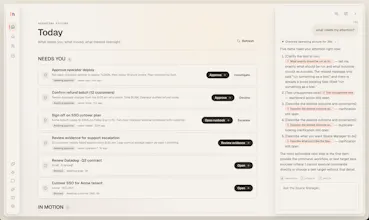
Hipocampus is a workflow-ownership layer for teams. It deploys governed operators that automate and own team workflows across fragmented systems, with persistent workflow state, approvals, delegation, escalation, and shared context so work keeps moving across tools and time.



RiteKit Company Logo API
Congrats on the launch! This is a compelling take on workflow automation. I'm curious about how Hipocampus handles context handoffs when operators need to escalate work back to humans—what does that experience look like for team members, and how do you prevent context loss in that transition?
@osakasaul Our operators aren't driven by a thin runtime, in essence a series of ephemeral chats. Instead, they are persistent in memory, state, and context, which allows them to continue working after weeks at a time.
Our architecture supports persistence at scale, unlike most of our competitors within this space.
Hipocampus
@osakasaul thank you. Great question. To add, when an operator needs a human, that handoff becomes a task with the context attached, not just a chat relay. The teammate sees a review item in their queue or inbox with the task, notes, comments, latest summary, and outputs. We avoid context loss by storing the work state outside the model: task history, ownership changes, comments, session summaries, notifications, and artifacts stay with the task, so work can move between operator and human without anyone having to reconstruct what happened from memory.
Hipocampus is built to learn the job as you do it. You do something once or twice with the AI helping, it starts to recognize the pattern, and then it can take the first pass on similar work on its own. When you come back, the draft or prep work is already there, and you can review it, tweak it, approve it, or send it back
@noureddin_bakir1 — given the distributed systems background, how do you handle consistency when an operator's state needs to survive model version changes or provider swaps? Most persistence layers I've seen for long-running agents break down when the underlying model behavior shifts mid-workflow.
Seriously cool! This feels like Zapier + Temporal + AI agents combined. Btw what’s been the hardest part in making that actually reliable in production?
@lak7 The hardest part was figuring out how to approach building Hippocampus. Since we both have a background from distributed systems, we realized this was just another distributed systems pattern. This is why we're ahead of the curve when it comes to production reliability, observability, and why we have the strongest harness given our intelligence layer.