
Gaia
AI architectural renders and interior design
93 followers
AI architectural renders and interior design
93 followers
AI rendering studio for architects, interior designers and DIY home renovators. Sketch, screenshot, or room photo to photorealistic render in seconds.
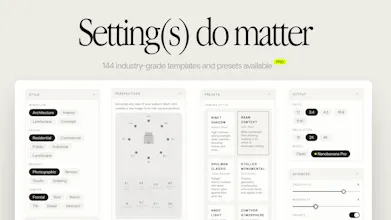
With 144+ industry-grade templates and presets available, Gaia is not another image generator, she remembers the best-practise materials, the light you keep choosing, the angles you approve:: and biases every future render toward your taste. Build your dreams into reality. 21,000+ renders. 2,500+ designers. 50 free renders, no card.



Free Options
Launch Team / Built With


Render: Get up to $100K in startup creditsThe fastest way to deploy and scale apps and agents
Promoted
hey PH! I'm Daan, a PhD researcher in AI and Architecture, and the person behind Gaia (btw: Generative AI Architect, and The Goddess of Earth:: we need to design better, quicker). Ive built many products my life; but Gaia is my favourite; she is a passion, intersecting work and fun at the right balance.
I built the first version at Cornell Tech in '23 with my co-founder Phil Parvaneh (<3) where I studied Computer Science withs specialisation in Urban Technology and AI. We had one of the first diffusion models trained on architectural output, tested by practicing architects - won the Cornell Startup Awards, got real users, then had to pivot due to some operational challenges.
My daily research is about how AI can simulate spatial experience before a building exists. Gaia was supposed to stay on ice until the models caught up; a dream where timing is everything. And then they did catch up, without us spending $1MM competing with foundational model providers. Finally.
Almost every day, architects kept messaging asking why we stopped building. Some had Gaia in their daily workflow eg "using this for a client pitch tomorrow, lmk why export not working" (quite remarkable given they were still using V0 Gaia, the pre-Cursor/Claude app we wrote by hand in Javascript (blood, sweat, tears)). When you hear that enough times and the tech is finally ready, you rebuild. So: 357 commits later, endless coding nights, and a few good wakeup calls on clarity:: I rebuilt everything from the ground up. Design system to infrastructure, model tweaking, prompt engineering, all after lab hours.
The camera presets are named after Hélène Binet, Julius Shulman, Ezra Stoller, Peter Zumthor -- because if you're going to control perspective, the references should mean something. That's the kind of decision a generic AI tool would never make. I tested every preset with 50+ practicing architects, asking: how do you design the best interface between actual work and "flashy" AI?
The thing I'm most proud of is the Digital Twin. Every session, a process called extract_style_dna builds a model of your design sensibility; the materials, the light quality, the compositions you keep approving. Over time, Gaia stops needing you to explain yourself. Every other tool on the market resets to zero each session. The model compounds, and feeds into a knowledge graph where every render is a node, edges are semantic relationships, and the shape of the graph reflects how your ideas connect. A few architects have told me they use it like a visual Obsidian for their design thinking.
Also in the toolkit: multi-perspective generation (street, aerial, section cut, interior -- one click each), reference image stacking with weighted inputs, brush-mask editing, PDF export for client decks, and an Interior AI with 20+ styles that a few hundred architects I know prefer over the alternatives. Also seeing a wave of homeowners using it to redesign their own rooms. Big win, no need to study 6 years?
so Gaia is not a startup anymore, no VC, complete freedom to build. It's a professional playground alongside my PhD, for the next few years. Expect more research-driven features. Instead of competing, I'm interested in how and why people actually use these tools. The academic angle is, I think, a real advantage.
50 free renders to start, or €24/month for unlimited (gotta cover the costs). DM me questions or email at daan@gaia.computer.
Students get 50% until end of studies, and if you're in one of my current classes, just reach out, I'll sort you out.
Daan van der Zwaag
really curious about the 'weighted reference image stacking' feature. does it allow for separate weights for 'texture' vs 'geometry,' or is it just a general influence slider? cong reaching the rebuild milestone, the interface looks super clean. @danoszz @Gaia
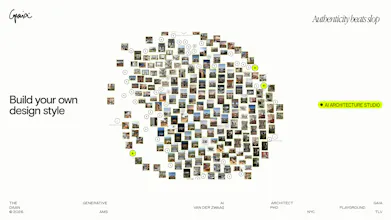
First version of Gaia: heavily fine-tuned stable diffusion + React UI, NYC, 2023