
LawCentral AI
AI case tracking & legal research for Indian lawyers.
20 followers
AI case tracking & legal research for Indian lawyers.
20 followers
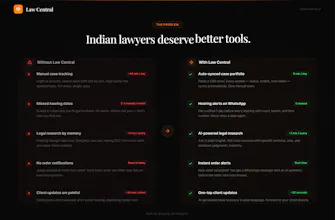
Indian lawyers waste hours refreshing eCourts for case updates. LawCentral fixes this. Paste a CNR number → get full case history, next hearing date, and judge info instantly. Research any legal question across 18,000+ Indian acts and Supreme Court/High Court judgments using AI. Get WhatsApp alerts before every hearing so you never miss a date. Built specifically for Indian litigation lawyers, not a generic legal tool adapted for India. Free to start.


Free Options
Launch Team

Dropbox SignSimple, secure eSignatures for the way your team works.
Promoted
Finally someone is solving the ecourts problem. I waste 20-30 minutes every morning just checking case status for my clients. The captcha alone makes me want to throw my phone. CNR lookup is the feature I didn't know I needed. How accurate is the data?
@sneha_adv_kulkarni The captcha pain is real, that's literally why we built CNR lookup first. Data comes directly from eCourts, so accuracy is the same as what you'd see on the site, just without the captcha and the 3-minute load times. We also show case history, next hearing dates, and connected party details in one view. For 20-30 cases, you should see a real difference in your morning routine. Try it and if anything looks off on a specific case, flag it to us, we take data accuracy very seriously.
Interesting product. How does the AI research compare to just using ChatGPT with the right prompts? Genuine question, I've been using GPT-4 for legal research and it's not that helpful.
@rajesh_menon282 Great question. The core difference, ChatGPT hallucinates citations. It'll give you a judgment name that sounds real but doesn't exist. We pull from actual indexed Indian case law, so every citation you get is real and verifiable. The other thing is specificity. Try asking ChatGPT 'Section 37 NDPS bail granted Rajasthan HC 2024' you'll get a generic explanation of Section 37. We'll give you the actual judgments with case numbers, bench, and date. It's the difference between a smart friend guessing and a research assistant who's actually read the judgments.
The Whatsapp bot is brilliant. Every lawyer I know including me checks Whatsapp 50 times a day. Getting hearing alerts there instead of email makes so much sense. Is it available for High courts and district courts?
@lalit_singh17 Yes, works for both High Courts and District Courts. The bot pulls from eCourts data, so if it's on eCourts, you'll get alerts. Most lawyers we've spoken to said the same thing, nobody opens email, but WhatsApp is already open 50 times a day. We're also adding next-hearing reminders the evening before, so you don't have to manually check your calendar. If you try it, let me know how it works for your setup, always looking for feedback on the alert timing and format.
Covered a lot of AI startups this year but legal tech in india is genuinely underexplored. Two questions,
How do you handle data privacy? Lawyers deal with sensitive information.
Any plans to expand beyond india?
@ananya_62desi
Two important questions.
We don't store any client-specific case documents on our servers. Research queries are processed and not logged against user profiles.
India first. The legal system here is complex enough, 18,000+ Acts, multiple court hierarchies, regional language barriers. We want to get depth right before width. That said, the underlying architecture (AI research, drafting, alerts) could work for any common law system. South Asia and Africa are natural next steps, but not before we've nailed India.