Launching today
AgentLeash

AgentLeash

See and control what AI agents touch in your codebase

2 followers

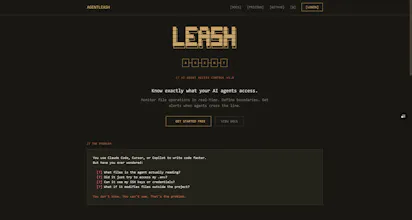
AI agents read your entire codebase. No visibility into what they access. AgentLeash fixes that. $ leash watch [✓] READ src/index.ts [X] READenv.local [BLOCKED] - Define boundaries – YAML path rules - Monitor everything – Real-time logs - Get alerts – Violation notifications Works with Claude Code, Cursor, Copilot. Free: 1 scope, 1K logs/day Pro $15/mo: 5 scopes, 10K logs Team $49/mo: 20 scopes, SSO, API Enterprise $149/mo: Unlimited, on-prem
AgentLeash gallery image
Free Options
Launch Team / Built With
Flowstep
Flowstep
Generate real UI in seconds
Promoted

What do you think? …

Skyler Kruger
Maker
📌
Hey Product Hunt 👋 I'm Sky, solo founder of VERIDIAN. I use AI coding agents daily—Claude Code, Cursor, Windsurf. They're transformative. But one thing kept bothering me: I had no idea what they were actually accessing. These agents read your entire codebase to build context. They can touch config files, environment references, lockfiles. And you just... trust that it's fine. So I built AgentLeash. It's file access monitoring designed specifically for AI agents: $ leash init $ leash watch Now I see every file operation in real-time. I define boundaries in a simple YAML config—block .env files, restrict writes to certain directories, set different rules for different agents. When an agent tries to access something restricted: [X] READ .env.local [BLOCKED] I get notified. I see the attempt logged. I stay in control. The free tier gives you 1 scope and 100 logs/day—enough to try it on a real project. I'd love to hear: - What files do you wish you could protect from agent access? - Any specific agent integrations you'd want? Happy to go deep on implementation or roadmap. — Sky