
The Leaderboard
by Product Hunt
Monday, May 25
Monday, May 25
No cloud, no cry
gm legends, happy Monday.
Today: an AI memory tool that never leaves your laptop, Mac automation that compiles once and bills you never, and a menu bar app that finally answers the drawer full of mystery USB-C cables. Also: what happens when vibe-coding hits architectural reality.
Your AI doesn't know you. Memdex does

Memdex captures your ChatGPT, Claude, and Gemini conversations and stores them encrypted on your laptop — IndexedDB, never uploaded. Open a new chat and it underlines the context you've already explained before, Grammarly-style, so you inject it with one click instead of retyping. Andrew Chan built it after spending most of last year repeating himself to three different AI models.
🔥 Our Take: Mem0 ships a similar Chrome extension and does something nearly identical — the difference is your conversations sync to their servers. If that bothers you, Memdex is the alternative that actually keeps your data yours. The free tier caps at 10 recent chats, which is enough to test the only real question: do the underline suggestions surface the right context, or do they flag the noise? If the suggestions are good, the $0 tier won't be enough for long.
Automation that runs on your clock
Freu AI records your Mac workflow once, compiles it to a deterministic local DSL, and runs it forever after with no tokens consumed and no recurring bill. The $0 claim holds because AI only runs during the recording phase. Charles (@charles99) is also open-sourcing freu-cli, the browser automation engine underneath it.
🔥 Our Take: Bardeen charges per action because it re-invokes AI at every step. Freu front-loads that cost to the recording phase, which means you pay once per workflow instead of every time it runs. The trade: Bardeen has a library of pre-built automations you can pick from. With Freu, you record each workflow yourself before it can run. If you have specific, repeatable tasks you do daily, Freu will likely pay for itself fast.
Your cables have been lying to you

WhatCable is a free macOS menu bar app by UK developer Darryl Morley (@daz1uk) that reads IOKit e-marker data from every USB-C port on your Mac and tells you in plain English what each cable can actually do: charging wattage, data speed, whether it's actually Thunderbolt. No external hardware. Your Mac already had this data.
🔥 Our Take: The USB-C spec lets any cable look identical on the outside while doing completely different things inside. Cable manufacturers have no reason to fix this — ambiguity sells cables. Darryl just surfaced the data your Mac already holds. One caveat worth knowing: passive cables with no e-marker chip show up as unknown, which sounds like a miss but is actually the most useful answer. A cable with no e-marker chip is almost certainly slow. Unknown means cheap.
I tried to vibe-code my way to a SaaS… and failed
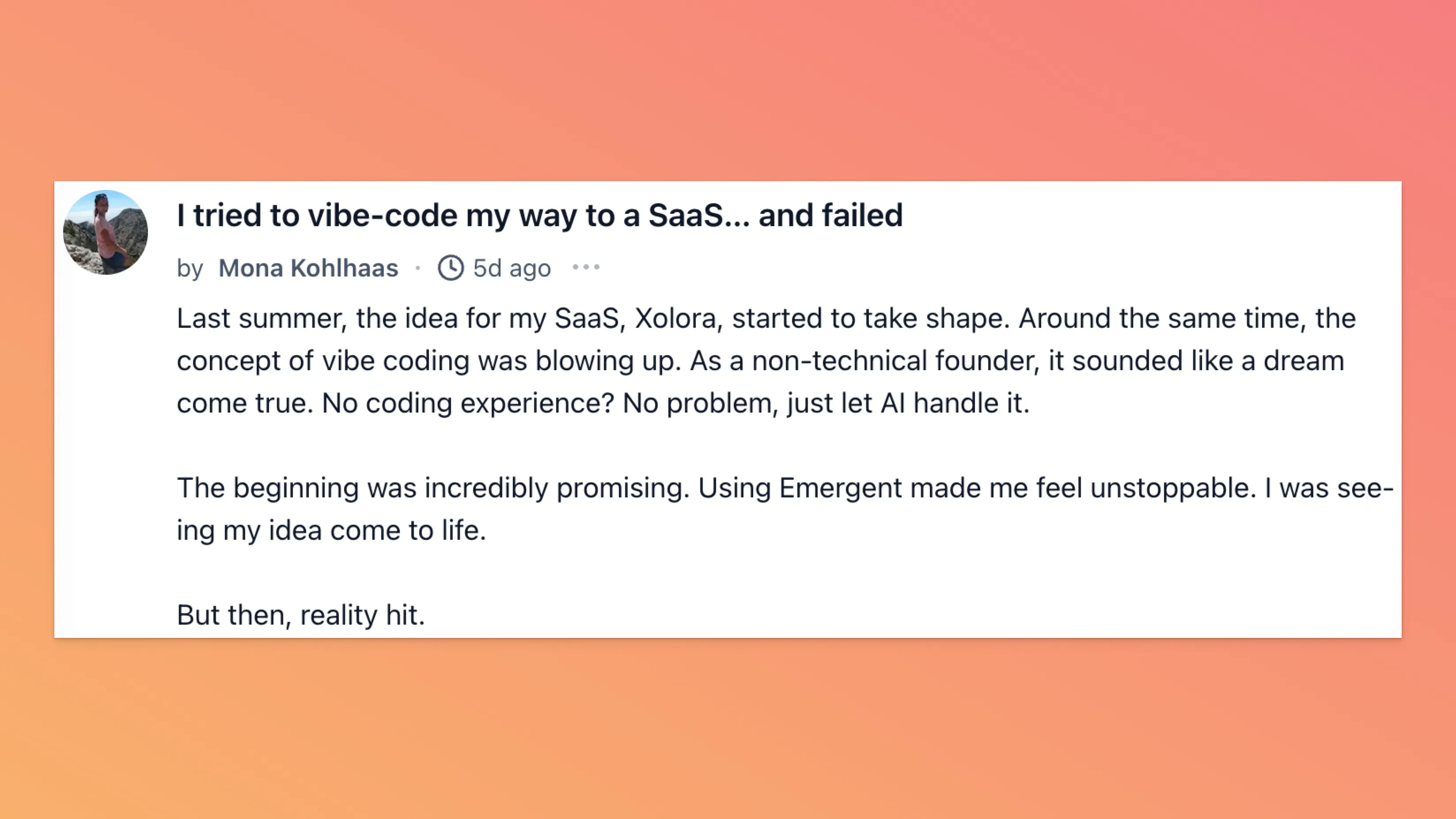
Mona Kohlhaas (@mona_kohlhaas) posted an honest breakdown of her vibe-coding failure: started a SaaS called Xolora, hit the wall when complexity increased, and ended up hiring a developer to rebuild it from scratch. She's not promoting anything. The product isn't finished.
The thread landed on a clean consensus without much disagreement. Vibe coding handles early velocity fine, then things start breaking faster than the AI can fix them. Daniel Henry said it works for validation but breaks on auth, scaling, and infrastructure. Ricardo Bruggemann, 20 years in, put it plainest: the architecture has to be solid first, then the model fills in the implementation.
Sharpest line: "The first 70% feels magical. The last 30% becomes architectural survival."
Daily Top Products


