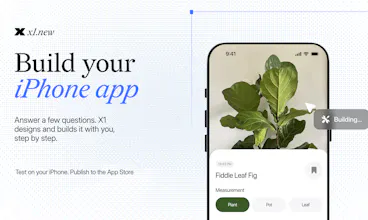
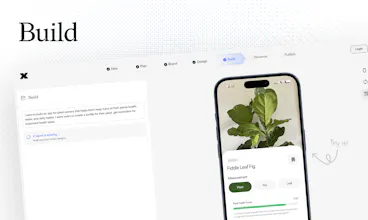
X1 is an AI app builder that takes you from an idea to an iPhone app you can publish on the App Store. Instead of trying to generate the entire app from one prompt, X1 guides you step by step. It asks focused questions, designs each screen for you to review and edit, then builds the app in stages. Preview and test it on your iPhone as you go. When it’s ready, X1 prepares your App Store listing, screenshots, and submission. No coding required.

@colton_drake Good question. The way I think about it, the two aren't in tension. X1 automates the build process, the actual work of getting the app made, but it never builds anything you haven't already approved. We don't quietly assume the important factors, we surface them for you to decide, just in a way that isn't a lengthy back and forth or a form, and it's not a one prompt to publish thing either.
The big control moments, reviewing the plan and every screen before it's built, are always yours. So X1 does the heavy lifting while you stay the one steering what actually gets built. However, we also cater to your everyday exploration mode where you are testing apps to see what sticks, so you even control how much control you want. You can absolutely let X1 take the wheel and roll with all the recommended routes without ever getting into a debate about it.
So if we talk about balance, it's up to you, you can take 100% of control, or none of it (I would advise against the latter tho lol)
@ristan_nakko Yeah, I had the exact same experience and it was infuriating because you could taste how close you were.
The app would be 80% there, then a few edits later the model would forget why something was built a certain way and start breaking other parts.
We’re definitely not perfect yet, but that’s really the mission with X1: keep enough context and structure around the product that every new change builds on what came before instead of slowly undoing it.
@abod_rehman Definitely more back-and-forth. We try to only ask when the answer would meaningfully change the app or create downstream decisions. If something is obvious or easy to change later, X1 just makes a reasonable call and keeps moving.
The questions are also based on your app and previous answers, so it shouldn’t feel like filling out the same form every time. The goal is basically to catch ambiguity before X1 turns it into a bunch of assumptions you discover 20 changes later.
@justin2025 That’s exactly the failure mode we’re trying to avoid.
If you pivot, X1 treats the old decisions as things to re-evaluate, not sacred memory. It updates the plan/underlying decisions, figures out what actually needs to change, and keeps the parts that are still valid instead of rebuilding everything from scratch.
The goal is for memory to preserve context, not trap you in it.
I really like the decision to focus on one platform and make the journey from idea to App Store much more guided. The step-by-step approach feels more practical than relying on one giant prompt. Congrats on the launch🚀
AI is already insanely good at the individual pieces. We just think the missing part is giving people a clear path through all of them without having to figure out the whole product/dev process themselves.
Report
Most launches would have claimed every platform. You went iPhone only and said exactly why, right in the thread. Congrats on the top spot, well earned.
this sounds much more controlled than typical AI builders! how do you balance automation with giving users enough control?
x1
@colton_drake Good question. The way I think about it, the two aren't in tension. X1 automates the build process, the actual work of getting the app made, but it never builds anything you haven't already approved. We don't quietly assume the important factors, we surface them for you to decide, just in a way that isn't a lengthy back and forth or a form, and it's not a one prompt to publish thing either.
The big control moments, reviewing the plan and every screen before it's built, are always yours. So X1 does the heavy lifting while you stay the one steering what actually gets built. However, we also cater to your everyday exploration mode where you are testing apps to see what sticks, so you even control how much control you want. You can absolutely let X1 take the wheel and roll with all the recommended routes without ever getting into a debate about it.
So if we talk about balance, it's up to you, you can take 100% of control, or none of it (I would advise against the latter tho lol)
HyNote AI
Been burned before by builders that forget context after a few edits. If X1 actually solves that, it's a real differentiator.
x1
@ristan_nakko Yeah, I had the exact same experience and it was infuriating because you could taste how close you were.
The app would be 80% there, then a few edits later the model would forget why something was built a certain way and start breaking other parts.
We’re definitely not perfect yet, but that’s really the mission with X1: keep enough context and structure around the product that every new change builds on what came before instead of slowly undoing it.
Triforce Todos
Curious how X1 decides what to ask you vs. what to just assume. Does it feel like a real back-and-forth or more like a form?
x1
@abod_rehman Definitely more back-and-forth. We try to only ask when the answer would meaningfully change the app or create downstream decisions. If something is obvious or easy to change later, X1 just makes a reasonable call and keeps moving.
The questions are also based on your app and previous answers, so it shouldn’t feel like filling out the same form every time. The goal is basically to catch ambiguity before X1 turns it into a bunch of assumptions you discover 20 changes later.
Mom Clock
What happens if you want to pivot halfway through, does it rebuild cleanly or does the "memory" start working against you?
x1
@justin2025 That’s exactly the failure mode we’re trying to avoid.
If you pivot, X1 treats the old decisions as things to re-evaluate, not sacred memory. It updates the plan/underlying decisions, figures out what actually needs to change, and keeps the parts that are still valid instead of rebuilding everything from scratch.
The goal is for memory to preserve context, not trap you in it.
ProductBridge
I really like the decision to focus on one platform and make the journey from idea to App Store much more guided. The step-by-step approach feels more practical than relying on one giant prompt. Congrats on the launch🚀
x1
@hareesh_vemasani Appreciate it 🙏 that’s exactly the bet.
AI is already insanely good at the individual pieces. We just think the missing part is giving people a clear path through all of them without having to figure out the whole product/dev process themselves.
Most launches would have claimed every platform. You went iPhone only and said exactly why, right in the thread. Congrats on the top spot, well earned.
x1
@lucasjpols Appreciate it man 🙏 honestly that focus is a big part of the product.