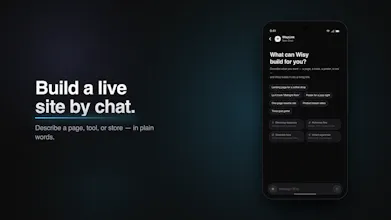
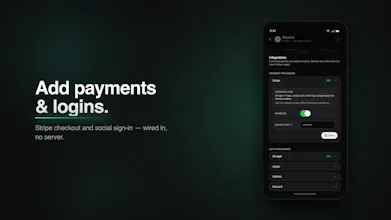
WisyLink turns a chat into a live website, app, or tool — no code. Hosted on its own address, with a real backend already wired in: accounts, a database, payment collection, and file storage, plus live updates and multiplayer when you need them. Bring your own domain or use a WisyLink one. Keep shaping it by chatting — the link never changes. Free to start, on web, iOS, and Android.
No reviews yetBe the first to leave a review for WisyLink
Maker
📌
Hi Product Hunt 👋
This is our first launch here — WisyLink turns a chat into a live website, app, or tool.
Most AI tools stop at generation: you get an output, then handle hosting, accounts, and infrastructure yourself. WisyLink builds the whole thing. Describe what you want, and it comes back live — on its own address, with a real backend already wired in: accounts, a database, payment collection, and file storage, plus live updates and multiplayer when what you're building calls for it.
It doesn't stop at the first version, either. Keep shaping it by chatting — the page updates in place, and the link never changes.
A couple of things we're curious to hear from this community:
• What's the first thing you'd try building with it?
• Where would "describe it, get a real backend" fall short for what you need?
Free to start on the Community plan, no card required. Live on web, iOS, and Android — we'll be following the comments closely today.
Report
How does the backend actually handle accounts and data if I'm just chatting to build it — am I trusting a black box, or can I peek at what's happening under the hood as the site evolves?
Report
Maker
@emirhan215488 Thank you for the great question, Emirhan — happy to explain exactly how this works. A link's backend doesn't exist until you create that link; from there, it's built out step by step alongside your link agent, and the whole platform is built to keep that backend, and everything inside it, fully isolated per link. Early on, we actually built a tool that gave direct access into a link's database — but we shelved it before launch, because it worked against that isolation principle and introduced security risks we weren't willing to accept. Instead, you get a built-in data visualizer and export, available across the whole platform, much like Supabase's table view, just without a raw connection string. So to answer directly: it's not a black box — you can see and export your data whenever you want, just not through a direct pipe that would put the isolation the rest of the system depends on at risk.
Report
how does it handle when lots of people are editing the same project at once, like does the chat actually talk back if two of us start changing things in parallel
Report
Maker
@halitmarali9g7 Thanks for asking, Halit — by design, our architecture runs on a multi-layered, multi-agent orchestration rather than firing off distributed parallel edits. Changes move through a planned, solid pipeline instead of racing each other.
Report
The fact that the link stays the same while you keep editing is genuinely clever, love that. One thing I'd want as a user though is some kind of access control on who can view the generated site, since right now it sounds like everything is either fully public or hidden, with no middle ground for something like a private beta or invite-only access without paying for a full account system setup.
Report
Maker
@saadetpz2y Thank you for the kind words about the persistent link, Saadet — and for the great question. Since WisyLink gives you a real backend behind every site, not just static hosting, this is actually something you can set up today: just tell the agent how you want it locked down. A "coming soon" page, a password gate, or even a setup where only you can preview it — no account system required on your end. You have a real backend, so you're free to choose exactly how private your link should be.




How does the backend actually handle accounts and data if I'm just chatting to build it — am I trusting a black box, or can I peek at what's happening under the hood as the site evolves?
@emirhan215488 Thank you for the great question, Emirhan — happy to explain exactly how this works. A link's backend doesn't exist until you create that link; from there, it's built out step by step alongside your link agent, and the whole platform is built to keep that backend, and everything inside it, fully isolated per link. Early on, we actually built a tool that gave direct access into a link's database — but we shelved it before launch, because it worked against that isolation principle and introduced security risks we weren't willing to accept. Instead, you get a built-in data visualizer and export, available across the whole platform, much like Supabase's table view, just without a raw connection string. So to answer directly: it's not a black box — you can see and export your data whenever you want, just not through a direct pipe that would put the isolation the rest of the system depends on at risk.
how does it handle when lots of people are editing the same project at once, like does the chat actually talk back if two of us start changing things in parallel
@halitmarali9g7 Thanks for asking, Halit — by design, our architecture runs on a multi-layered, multi-agent orchestration rather than firing off distributed parallel edits. Changes move through a planned, solid pipeline instead of racing each other.
The fact that the link stays the same while you keep editing is genuinely clever, love that. One thing I'd want as a user though is some kind of access control on who can view the generated site, since right now it sounds like everything is either fully public or hidden, with no middle ground for something like a private beta or invite-only access without paying for a full account system setup.
@saadetpz2y Thank you for the kind words about the persistent link, Saadet — and for the great question. Since WisyLink gives you a real backend behind every site, not just static hosting, this is actually something you can set up today: just tell the agent how you want it locked down. A "coming soon" page, a password gate, or even a setup where only you can preview it — no account system required on your end. You have a real backend, so you're free to choose exactly how private your link should be.
DesignQA
This is incredible! Congratulations Mustafa!
@mahdif Thank you, Mahdi! This really means a lot, truly appreciate all your support!