
Waveflow
Simulate RIS systems before you build them.
1 follower
Simulate RIS systems before you build them.
1 follower
Stop wrestling with expensive physical prototypes and fragmented data silos. Waveflow natively combines propagation physics, ML-guided beam sweeping, and link quality analysis into a highly-efficient Python engine. It just works.
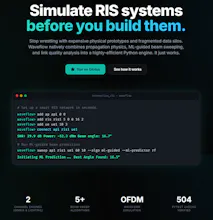

Waveflow was built to solve a simple but expensive problem: RIS research and prototyping are often slowed down by fragmented tools, manual calculations, disconnected ML pipelines, and heavy physical setup requirements. Existing workflows may be powerful, but they are frequently complex, time-consuming, and difficult to scale.
Waveflow consolidates that process into a unified Python-native environment. Users can model AP, RIS, and UE topologies, simulate wireless propagation, evaluate SNR and link quality, perform beam sweeps, analyze OFDM behaviour, and apply ML-guided optimization through a Python API, interactive CLI, or modern terminal UI. The platform also simplifies integration with computer vision pipelines, machine learning frameworks, and MATLAB-based analysis workflows without requiring researchers to rebuild surrounding infrastructure from scratch.
A core strength of Waveflow is its dual-engine architecture. SimRIS supports literature-aligned stochastic channel analysis for research-oriented evaluation, while LightRIS is optimized for high-speed analytical computation, large-scale parameter sweeps, adaptive feedback experimentation, and ML-driven optimization. Together, they provide both scientific depth and practical execution speed within a single platform.
What makes Waveflow compelling is that it does not attempt to add more complexity to RIS development. Instead, it removes unnecessary friction. By building the platform entirely around Python, Waveflow becomes easier to extend, faster to iterate on, and more accessible to researchers and engineers seeking rapid experimentation without heavyweight tooling overhead.
Waveflow is more than a simulator. It is an integrated environment for building, testing, optimizing, and refining RIS systems before real-world deployment.
What inspired me to build Waveflow was a simple observation: many existing tools are powerful, but they often feel too complex, too heavy, and too slow for people who just want to get things done efficiently. I wanted to build something that felt lighter, faster, and much easier to use without losing real capability.
The problem I was trying to solve was the friction created by complicated workflows and tools that demand too much time and effort just to accomplish simple but important tasks. With Waveflow, the goal was to create a smoother experience where things feel more accessible, more intuitive, and significantly faster. By generating Waveflow with Python, the development process also became much more efficient, which allowed ideas to be translated into working solutions more quickly and with less overhead.
As I worked on the launch, my approach evolved from focusing mainly on building the product to thinking more deeply about usability, positioning, and adoption. Early on, the focus was on making sure the system worked. As the launch took shape, it became more about refining the experience, simplifying the message, and making sure Waveflow was not just functional, but immediately clear and valuable to the people using it.