Launching today

Venkat's Interactive AI Portfolio
AI portfolio with RAG, 50ms browser TTS engine & admin ($0)
2 followers
AI portfolio with RAG, 50ms browser TTS engine & admin ($0)
2 followers
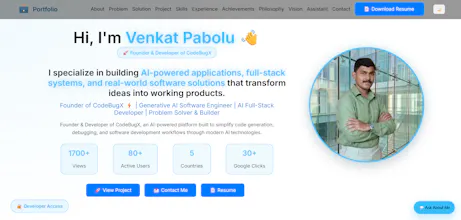
An AI Portfolio ecosystem engineered at zero cost. Built for tech developers, founders and recruiters to replace passive, static resumes, this zero-cost AI Portfolio ecosystem bypasses expensive CMS and ElevenLabs platforms. It features an intelligent RAG assistant with live web search grounding, a custom 50ms browser TTS speech-highlight engine, and a custom 3-pass biometric secure Developer Area functioning natively inside the website viewport to control access to confidential assets.




Free
Launch Team / Built With


AWS Startup AdvisorPersonalized AWS guidance that meets you where you’re already building
Promoted
Hi everyone at Product Hunt,
I am Venkat Pabolu from india, a B.Tech CSE graduate, Founder & Developer of CodeBugX, and an AI-Native Software Engineer focused on GenAI application development.
I independently deployed CodeBugX (an AI-powered SaaS platform with code generation, conversion, and debugging) as my first full-stack application at zero cost ₹0 ($0). To challenge myself, I decided to build my portfolio itself as a fully integrated, live software project rather than a static website.
I engineered my portfolio as the world's first AI Portfolio ecosystem at zero cost ₹0 ($0) featuring innovative systems like a focused RAG-based AI assistant, a custom browser-based speech-highlighting and auto-scrolling engine, and a protected Developer Area with multiple biometric layers.
Don't just show my portfolio. Let visitors experience it. Here is how the entire ecosystem operates across its 3 core systems:
1. THE PORTFOLIO-FOCUSED RAG AI ASSISTANT
My AI portfolio helps visitors interact with my AI Assistant conversationally—designed exclusively to talk about me, my work, and etc anything of me.
• Intelligent Context Routing & RAG:
The assistant evaluates incoming queries against my structured knowledge base, acting as a personalized RAG agent with real-time web grounding.
• Dynamic Web Search Integration & Real-World Context Fusing:
If a question requires external facts, it triggers an integrated web search tool—connecting information about my work with real-world trends, while securely anchoring parameters to my portfolio data.
2. REAL-TIME SPEECH-SYNCHRONIZATION & HIGHLIGHT ENGINE ECOSYSTEM (10ms–50ms TTFA and $0 COST) IN PORTFOLIO and ITS CHALLENGES
Building an AI Assistant was only the first step. I wanted to create a multi-sensory user interface where visitors ask a prompt and watch the layout speak, visually highlight, and auto-scroll in sync.
I engineered this engine as the world's first integrated system combining Browser TTS AI speaking + Custom Highlight Engine + Auto-Scrolling working live in a real AI portfolio chat.
To achieve this with zero network lag, I bypassed platforms like ElevenLabs and built my own Highlight Engine running entirely on client-side browser Text-to-Speech (TTS) voices.
I bypassed a $30–$50 (₹2,848-₹4,747)/month cloud API and by using Browser TTS with 10ms–50ms total Time-to-First-Audio (TTFA) and writing hundreds of lines of custom code for highlight engine at ₹0 ($0) cost—instead of using ElevenLabs ($30–$50/mo and 200ms–500ms TTFA).
By running natively in the browser, it completely eliminated:
• Network Transit Lag: 0ms (no server roundtrip for audio bytes)
• Model Inference Latency: 10–35ms (local OS speech dispatch)
• Audio Player Buffer Jitter: 0ms (direct DOM node event binding)
• Pipeline / Chunk Starvation: 0ms (stream token buffering mapped to onboundary)
The Engineering Challenges Behind the Build:
Synchronizing browser TTS voices with streaming text introduces massive bottlenecks because browser engines do not act like simple word-by-word string readers. The data streaming contains complex elements beyond normal text, including:
• Punctuation and sentence boundary pauses that throw off index timing loops.
• Special characters and symbols that display visually but alter character counting arrays.
• Markdown formatting codes (like bold text syntax blocks) and dynamic URLs where visual content lengths and spoken interpretations stop matching.
This causes character index drift where standard highlighting loops break completely.
The Engine Architecture & Device Constraints:
To solve this layout drift, my custom Highlight Engine manages an internal streaming buffer queue. It isolates structural formatting code for the audio voice engine while tracking the browser's native 'onboundary' states and mapping active visual tokens directly back onto the DOM in real time.
Important Technical Constraint (Screen Viewports):
This layout-synchronized speech highlight engine was engineered exclusively for PC, laptop, and desktop monitors. Because mobile browsers use fragmented local voice engines that drop boundary tracking signals, only the "AI Speaking" functionality operates on mobile screens. Full layout synchronization and dynamic scrolling require a desktop viewport.
3. IN-VIEWPORT DEVELOPER AREA CONCEPT ($0 COST CMS BYPASS) IN PORTFOLIO
While engineering the visitor experience, I started thinking deeply about the other side of a personal website: What about the developer who manages, updates, and controls it?
Usually, website management tasks, security logs, and database permissions are handled completely outside the app through third-party hosting consoles or flat files. I introduced and built this as the world's first Developer Area concept to prove a website can contain its own protected, self-governing administrative workspace operating natively live directly inside my portfolio web viewport.
I bypassed external CMS tools (like Contentful, Storyblok, Sanity, and Webflow, which cost $50–$600+/month or ₹4,747–₹56,670+/month) by engineering a Developer Area as internal management workspace at ₹0 cost:
It solves 4 core engineering and operational bottlenecks natively:
• Operational Problems: Eliminates jumping between external admin dashboards and deployment consoles.
• Security & Access Problems: Replaces static password pages with a localized, multi-pass cryptographic gate.
• Financial Problems: Zeroes out recurring CMS subscription fees ($0 operational overhead).
• Design Philosophy Problems: Proves a website can act as its own sovereign application rather than a passive brochure.
Multi-Pass Biometric Verification Gateway:
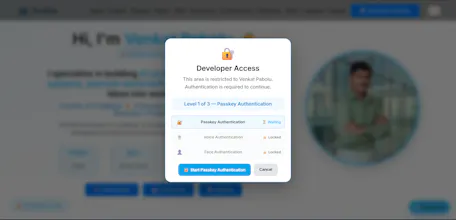
To enter this restricted developer zone, I engineered a highly secure, multi-pass cryptographic framework right inside the portfolio dashboard:
1. Google OAuth Authentication: Handles the primary layer of credential checks.
2. Device Passkey Authentication: Integrates secure hardware-level WebAuthn protection.
3. Voice Verification: Runs local voice phrase check as an interactive biometric experience.
4. Face Verification: Executes client-side facial enrollment checking as the final authentication loop.
The Core Real-World Use Case:
I built this secure workspace to guard confidential project references. My portfolio features a private "Achievement Proof Gallery" filled with verification files and analytics connected to my CodeBugX SaaS deployment. Through my protected Developer Area, I act as the system administrator—managing permissions, validating requests, and generating specific credentials for recruiters or tech founders to securely open the proof gallery.
This Developer Area concept is universally usable by any developer to manage, control, and gate custom workflows directly inside their own web apps.
This is my AI Portfolio with these innovative features I built—moving beyond a static page into an interactive, multi-sensory software ecosystem and i built it as my 2nd major project after CodeBugX platform.
I built this, it's live, you're welcome to explore it, and I'd value your thoughts on the markdown tracking algorithms, queue buffering, or the Developer Area logic and anything of my portfolio.
Thank you for checking out my project! ❤️