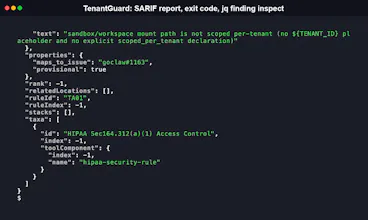
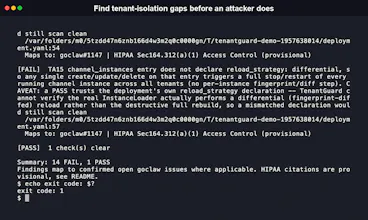
TenantGuard is a purpose-built CLI and MCP server for securing multi-tenant AI-agent deployments. While broad governance tools and general IaC scanners miss agent-specific isolation defects, TenantGuard goes deep. Using 16 fail-closed OPA/Rego rules mapped to real-world vulnerabilities, it instantly catches unscoped sandbox mounts, cross-tenant cron bindings, SSRF tool URLs, and exec credential leaks. It outputs in SARIF, JSON, and MCP and is licensed with Apache-2.0.
As we started deploying self-hosted, multi-tenant AI agents, we realized standard IaC scanners and broad AI governance platforms were missing critical vulnerabilities. General tools simply weren't designed to catch the nuanced, agent-specific isolation defects that can lead to catastrophic cross-tenant data breaches.
Initially, we tried adapting existing security scanners, but the approach was too broad. We realized we needed to go deep on a single, critical failure class: tenant isolation. That’s what inspired TenantGuard. We evolved our approach to focus exclusively on real-world exploits, mapping our policies directly to confirmed vulnerabilities rather than theoretical risks.
TenantGuard is an open-source (Apache-2.0) CLI and MCP server built specifically to audit multi-tenant AI-agent deployments. Powered by 16 fail-closed OPA/Rego rules, it instantly detects:
- Unscoped sandbox mounts
- Cross-tenant cron bindings
- SSRF-exposed tool URLs
- Credential leakage via exec tools
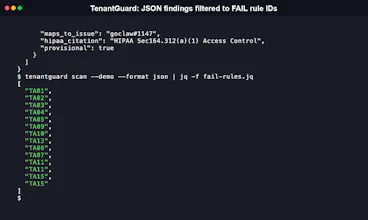
It natively outputs to SARIF, JSON, and MCP, so it drops seamlessly into your existing CI/CD pipelines.
Repo: https://github.com/RudrenduPaul/...
MCP Servers:
https://mcpservers.org/servers/r...https://glama.ai/mcp/servers/Rud...
PyPI: https://pypi.org/project/tenantg...
NPM: https://www.npmjs.com/package/te...
We built this for the community and would love your thoughts.
What is the biggest security hurdle you’ve faced when deploying AI agents in production?