
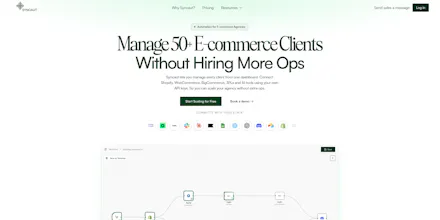
Most automation tools weren't built for agencies. You get one flat account, no client separation, and you're rebuilding the same workflows from scratch every time a new client comes in. Syncaut fixes that. Every client gets their own workspace. Build a workflow once, save it as a template, deploy it to every client in seconds. Flat pricing — unlimited workspaces, unlimited workflows. No per-task fees, no AI markup. Bring your own API keys.



@okosa_leonard How does the templating system work?
@suyash_kr Hello Suyash, thanks for asking. You build a workflow, save it as a template, and deploy it to any client workspace in seconds. Each client gets it connected to their own credentials so nothing mixes.
Basically your best workflows become reusable. Build a Shopify to Klaviyo sync once, deploy it to every new client forever. Never rebuild from scratch again.
You can keep templates private, share them with your team, or publish them publicly for other users to find.
How does inviting collaborators work in syncaut?
@kumar_ritesh21 Inviting collaborators in Syncaut happens at the workspace level.
You simply invite someone (usually via email), and once they accept, they join that workspace with a defined role (e.g., member or admin). From there, they can access the same workflows, automations, and integrations based on their permissions.
@okosa_leonard So what's the essence of workspaces?
@abhiranjan_mehta Workspaces in Syncaut are separate environments for teams or projects.
They keep everything organized and isolated—your workflows, data, integrations, and team members all live inside a workspace. This makes collaboration easy, prevents data mixing between users/clients, and sets the foundation for permissions, scaling, and billing.