
Stacktora
Define once, run anywhere.
7 followers
Define once, run anywhere.
7 followers
This is developer onboarding infrastructure. The end of configuration drift for every engineer — it’s over. Stacktora isn't a docker-compose generator. It's the workflow that keeps every developer's environment identical, current, and runnable — from the first clone to the hundredth hire. Define your stack — languages, databases, services — and Stacktora generates a production-ready, runnable bootstrap: docker-compose, Makefile, CI, and 15+ files. Clone, to running in minutes.



The bigger bet
Where we said stacktora.json was headed — and how much of it is already real.
We're onto something 🤫
Vault is now shipped!!! https://stacktora.com/vault/node-stripe-saas
CLI & stacktora.json
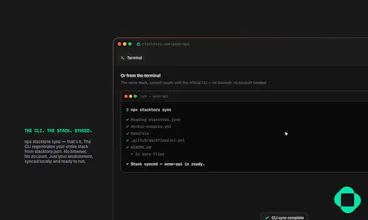
Every project includes a stacktora.json — a small, secret-free record of your stack (runtime, datastores, services, ports, options). The official Stacktora CLI reads that file and regenerates your project's files locally, using the exact same engine as this site — no account, no network, fully offline.
Path to production
Local compose is for development. Two optional outputs give you a real path out of it, and they solve different problems — pick based on how you actually want to run this in production.
Kubernetes mirrors your whole stack onto a cluster. Toggle it on and Stacktora generates k8s/manifests.yaml — a namespace, a Secret with your app env, a Deployment + Service for the app, and a Deployment + Service + PersistentVolumeClaim for each stateful datastore. In-cluster hostnames match the Service names, so your connection strings work unchanged.
The included k8s/README.md is explicit that this is a starting point — before real production add Ingress + TLS, resource requests/limits, liveness/readiness probes, an autoscaler, and proper secret management (Sealed Secrets / external-secrets), and prefer managed datastores where you can. Once you're running for real, node-level cost optimization (Karpenter, Cast AI) is the natural next stop — outside what Stacktora generates, but worth knowing about.
Fly.io is the simpler option if you don't want to run a cluster. Toggle it on and Stacktora generates fly.toml — but be clear about what it does: Fly deploys your app container only, not a multi-service stack. It doesn't run docker-compose-style setups from one config file the way a cluster can.
The included fly/README.md lists the exact attach command for each datastore you selected — Postgres and Redis have first-party managed options on Fly; anything else needs its own small Fly app or an external managed provider, and the README says so plainly rather than pretending otherwise.