Launching today

Spendhog is a household budget app with no bank connection. You, or a CSV import, record what happened, and it explains why the month went the way it did: what changed, what was a one-off, and whether you can still afford what you are saving for. A health score you can take apart, forecasts that say how sure they are, budgets for bills that are not monthly, goals tied to real balances. Up to 3 people per household, CHF, EUR and USD. Built in Switzerland.




Hi Product Hunt 👋
Spendhog started as a spreadsheet called Poupanças (Portuguese for "savings") that a former CFO in my family built for us. We're five people: shared bills, kids' activities, holidays, and the occasional "let's just order food tonight". The spreadsheet made our money visible, but it could never tell us why a month went the way it did.
So I rebuilt it in Switzerland, with that CFO as my adviser, and added the part a spreadsheet can't do: it explains your own data back to you. What changed this month, what was a one-off, and whether you can still afford what you're saving for. I'm a product designer who has spent a career on the software wealth and asset managers work in, and I wanted a household to get the kind of explanation professionals get.
A few choices that might be unusual:
• No bank connection, on purpose. You (or a CSV import) enter what happened, because seeing each entry is what keeps you aware, and there's nothing to break when your bank changes something. Also, a gift bought at a supermarket shouldn't be categorized as "groceries".
• The health score shows its working: open any part of it and see how it's calculated.
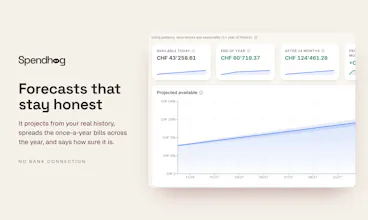
• Forecasts say how confident they are, and refuse to guess when there isn't enough history.
• The assistant is off until you turn it on, and even then never sees a transaction: only totals, and the words you write, as vocabulary.
• One plan with everything in it. Up to 3 people per household, in CHF, EUR or USD.
It's a web app you install from the browser. 30 days free, no card. The first 30 households to subscribe keep the founder price, 8.99 a month, for as long as they stay subscribed.
I'd love to hear what you'd need before trusting an app with your household's money, and where it falls short.
Interesting approach. Most budgeting apps I've tried are pretty good at telling you where the money went, but not necessarily why the month ended up the way it did. I also like that it works without connecting a bank account. Curious to see how it develops.
@ruth_oliveira1 Thank you Ruth. To be honest, I knew so well what I wanted as a product, that I did close to no research at all. I wanted to solve my problem first. So I can't say I tried that many apps in the last year or so. The non connection to the bank was the hardest UX decision I had to make. For me its vital to launch the transactions by hand. These automated imports categorize things wrong and hide crucial awareness from the user. I trully believe it needs to be done by hand, so most of my effort went to make it as easy as possible to launch by hand with automations in the right place.
Sometimes we wonder where the money went, but it’s rarely one big expense… it’s all the little things adding up without us noticing. With kids, groceries and everyday family life, that’s easy to recognise 😅
I like the idea of understanding why the month went the way it did. Seeing the numbers is one thing; knowing what we can change is what makes them useful. And being able to do that without giving access to my bank account is a big plus for me.
@paulo_freire_ramos Hey Paulo, thank you for the comment. Absolutely! I felt the same. Since I build financial products for a living, I thought of applying those same principles I use for portfolio and risk managers, for people like us that would also benefit from some "analytics". Cheers, hope you like!